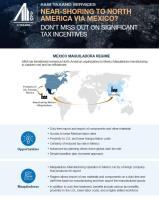
Mexico Maquiladora Regime - Don't Miss Out on Significant Tax Incentives
Driven by upheavals to the global supply chain and increased transportation and labor costs, many companies recognize that a more regionalized approach to their supply base may provide longer-term resilience and reduced costs and may also offer other proximity benefits.
For their North America markets, this regionalization often takes the form of nearshoring production to Mexico. In addition to lower manufacturing and transportation costs, closer time zones, less cultural discrepancies, and a greater level of control in decision-making processes, many companies nearshoring to Mexico also gain tax, trade, and other benefits by operating under the Mexico maquiladora program.
To learn more, download the Mexico Maquiladora Regime brochure.
Learn More:
Companies and commentators have spent the last year expending much effort in order to understand which of COVID-19’s many upheavals will be temporary and which will endure for the long term. Supply chains have been at the heart of many of these changes.
We review the overall supply chain network and core functional areas to quickly assess current state operating performance and define opportunities to improve EBITDA and working capital.
Enterprise Management Incentive Plans - Recent Changes and Common Pitfalls
August 5, 2026
Enterprise Management Incentive (EMI) option plans have been at the centre of UK employee incentivisation for many years and remain popular with privately owned, fast-growing companies.
2026 Multistate and Transaction Tax Highlights: Q1 and Q2
August 4, 2026
Multistate and Transaction Tax Insights for 2026 Q1-Q2: SALT updates, PTET changes, sales and use tax, and Canadian indirect tax developments.
The NYC Pied-à-Terre Tax: What Owners of Second Homes and Co-Ops Need to Know
August 4, 2026
NYC Pied-à-Terre Tax Explained: Deadlines, thresholds, exemptions, Phase 1 vs. Phase 2 valuation, co-op implications, and action steps for property owners.
A&M Tax Policy Quarterly Outlook: Q2 2026
July 31, 2026
Explore the latest global tax policy and controversy developments from Q2 2026.
Featuring expert insights on OECD, Pillar Two, and tax transparency.