Section 232 Pharmaceutical Duties: UK Rate Cut to Zero, and the Origin and Section 301 Questions That Follow
At a Glance
Effective July 31, 2026, the additional Section 232 tariff on patented pharmaceuticals that are products of the United Kingdom was reduced from 10% to zero (heading 9903.04.63), implementing the U.S.–UK Pharmaceutical Pricing Arrangement. Because UK patented pharmaceuticals remain subject to Section 232 (at a 0% rate), they also fall within the Section 232 carve-out from the new Section 301 forced labor tariffs — so qualifying UK patented product should face no additional duty under either regime.
Two consequences deserve attention. First, country of origin for these products is likely to track the origin of the active pharmaceutical ingredient, not the country where the drug is put into dosage form — a settled CBP position that constrains tariff-engineering and is a probable enforcement focus. Second, the Section 301 pharmaceutical relief is built around ingredients, not finished drugs, which leaves generic finished products more exposed than their patented counterparts.
Background
On April 2, 2026, the President issued Proclamation 11020, “Adjusting Imports of Pharmaceuticals and Pharmaceutical Ingredients Into the United States,” imposing additional Section 232 duties on certain imports of patented pharmaceuticals and their ingredients — active pharmaceutical ingredients (“APIs”) and key starting materials. See 91 FR 18183. The measure covers merchandise in Chapters 29 and 30 of the Harmonized Tariff Schedule of the United States (“HTSUS”). Generic pharmaceuticals and their associated ingredients are not subject to the additional duties, and pharmaceuticals that are products of the United States are excluded.
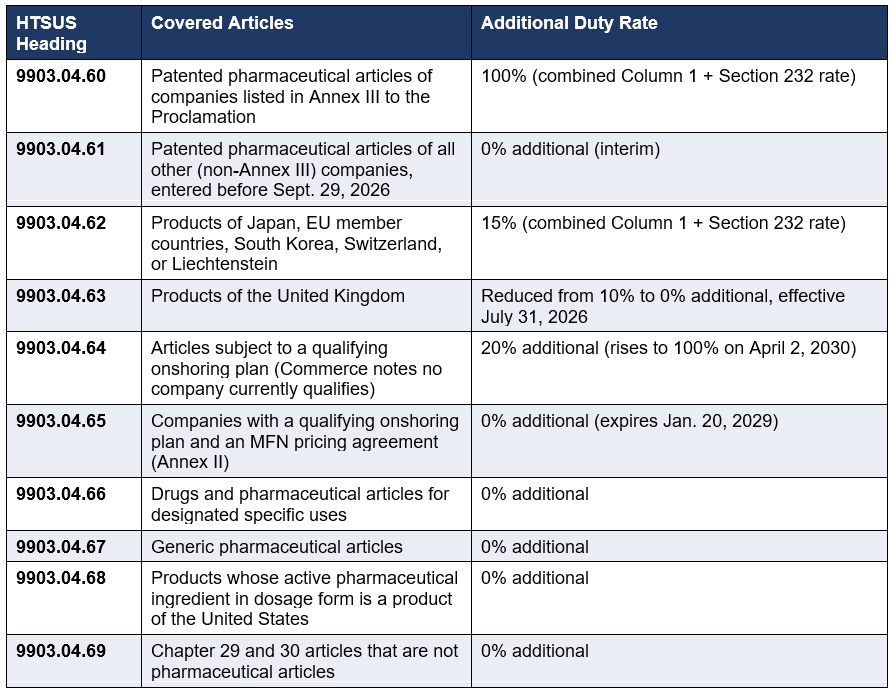
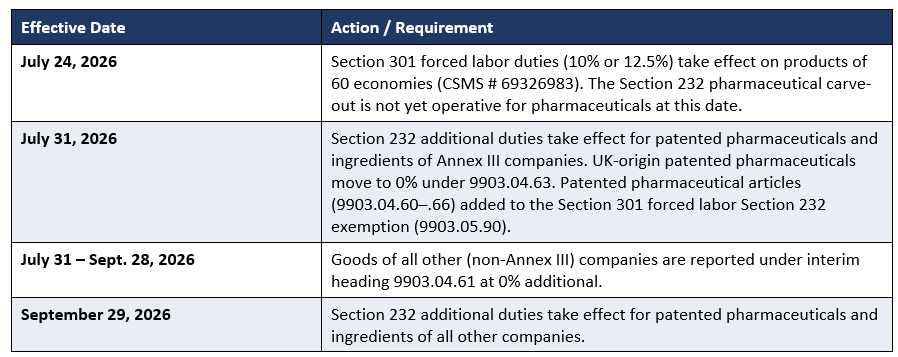
On July 30, 2026, U.S. Customs and Border Protection (“CBP”) issued CSMS # 69395344, establishing HTSUS headings 9903.04.60 through 9903.04.69 and instructing importers on reporting. The additional duties are effective July 31, 2026 for products of companies listed in Annex III, and September 29, 2026 for products of all other companies.
On July 31, 2026, the Secretary of Commerce published a notice reducing the additional rate on patented pharmaceuticals and ingredients that are products of the United Kingdom from 10 percent to zero, effective July 31, 2026, implemented through CBP guidance in CSMS # 69415934. The reduction follows the U.S.–UK Pharmaceutical Pricing Arrangement; Commerce determined the conditions of section IV.1.a of that Arrangement are being met, and amended heading 9903.04.63 by replacing “+10%” with “+0%.”
Scope of the Measure
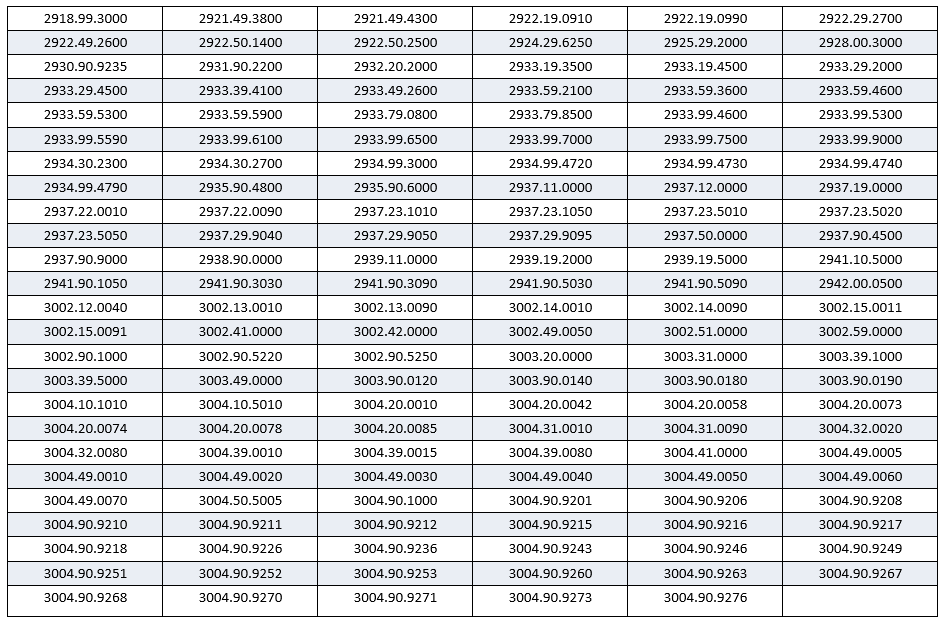
The additional duties apply to patented pharmaceutical articles and to the APIs and key starting materials used in their production. Covered merchandise is identified by 149 Chapter 1–97 HTSUS classifications in Chapters 29 and 30, as set out in subdivision (c) of U.S. note 40 to subchapter III of Chapter 99. The full list is reproduced in Appendix A. Effective July 31, 2026, importers of goods in the subject classifications must report an applicable Chapter 99 heading even where the additional rate is zero. Key carve-outs:
- Generic pharmaceuticals and their ingredients are not subject to the additional duties (heading 9903.04.67).
- Products of the United States — where the API in dosage form is a product of the U.S. — are reported under heading 9903.04.68 at 0% additional.
- Non-pharmaceutical articles in the subject Chapter 29 and 30 classifications are reported under heading 9903.04.69 at 0% additional.
Chapter 99 Reporting and Rate Structure
The headings are mutually exclusive — an article is subject to no more than one. Where more than one rate could apply under the Proclamation, the lowest applicable rate governs.
Key Effective Dates
Country of Origin — A Likely Enforcement Focus
Because the additional duty turns on the country of origin of the finished article, and because the rates differ sharply by country (0% for the UK, 15% for the EU and certain others, up to 100% for Annex III companies), origin determinations will drive duty exposure — and create incentives to characterize processing steps as origin-conferring. CBP’s long-standing position limits that room.
For pharmaceuticals, CBP has consistently held that processing a bulk API into finished dosage form — tabletizing, encapsulating, or otherwise measuring an API into doses — does not substantially transform the product. Origin generally follows the API. In HQ H267177, for example, acyclovir API of Chinese and Indian origin processed into tablets through multiple manufacturing steps was held to remain a product of the API-source countries. CBP has applied the same reasoning across numerous rulings (e.g., naproxen, ibuprofen, valsartan), finding that mixing an API with inactive ingredients into finished tablets abroad does not change origin. Where processing is chemically complex — for instance, combining two APIs into a new therapeutic product — CBP has found substantial transformation, so the line is fact-specific; but ordinary fill-finish does not cross it.
Practical implications of the origin rule
Interaction with the Section 301 Forced Labor Tariffs
On July 24, 2026, new Section 301 duties of 10% or 12.5% took effect on products of 60 economies found to have failed to prohibit imports made with forced labor (CSMS # 69326983), implemented through headings 9903.05.20–9903.05.84 with exemptions in U.S. note 52 to subchapter III of Chapter 99. Two separate exemptions matter for pharmaceuticals, and they operate differently:
- Section 232 carve-out (heading 9903.05.90 / Note 52(f)). Goods already subject to designated Section 232 programs are exempt. Effective July 31, 2026, patented pharmaceutical articles under headings 9903.04.60–9903.04.66 were added to this carve-out. Because UK patented pharmaceuticals remain subject to Section 232 at a 0% rate, they qualify — subjection, not the rate, is what matters. Result: no additional duty under either regime.
- Pharmaceutical-use exemption (heading 9903.05.89 / Note 52(e)). A separate exemption covers “articles for use in pharmaceutical applications” classifiable in an enumerated list of HTSUS provisions. This exemption is not conditioned on Section 232 subjection, so it can reach goods (including generics) outside Section 232 — but only if the specific HTS line is on the list and the pharmaceutical-use condition is met.
We reviewed the enumerated 9903.05.89 list (approximately 700 provisions) against the 149 Section 232 covered classifications. The overlap is highly asymmetric and instructive:
- Chapter 29 (bulk chemicals, APIs, intermediates): 43 of the 60 covered eight-digit headings also appear on the 9903.05.89 pharmaceutical-use list — broad overlap.
- Chapter 30 (finished / dosage-form drugs): only 1 of the 28 covered eight-digit headings appears (3003.31.00, a bulk-form insulin provision). Almost no finished-drug headings of the 3004 series appear on the pharmaceutical-use list at all — and none of the 3004-series headings within the Section 232 covered list do.
In other words, the Section 301 pharmaceutical exemption is built around ingredients, not finished drugs. The list is overwhelmingly Chapter 29 (roughly 577 of its 700 provisions). The consequence is a counterintuitive split in how patented and generic pharmaceuticals reach relief from the forced labor duty:
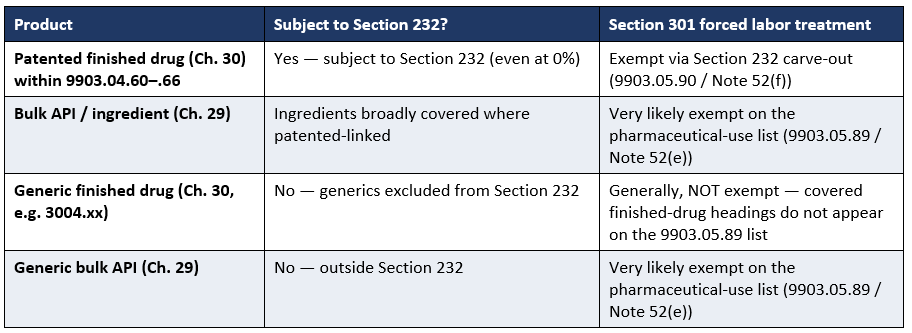
The practical takeaway: a generic finished drug (Chapter 30) from a covered economy is the exposed link. It is outside Section 232 (so no 9903.05.90 relief), and its finished-drug heading is generally absent from the 9903.05.89 list (so no Note 52(e) relief) — meaning it can bear the full 10% or 12.5% forced labor duty. Its patented counterpart within 9903.04.60–.66 is carved out via Section 232, and the bulk API for either is very likely exempt on the pharmaceutical-use list. Combined with the origin rule above, a generic finished abroad from Chinese- or Indian-origin API remains a product of that country, sits in Chapter 30, and generally finds no pharmaceutical escape hatch from the forced labor duty. The 43 overlapping Chapter 29 headings are listed in Appendix B.
Section 301 excess capacity investigation — forward-looking
Separately, USTR has an open Section 301 investigation into structural excess capacity in manufacturing (16 economies, initiated March 2026). As of the date of this alert, that investigation has not produced a proposed or final tariff action, and there is therefore no excess-capacity exclusion list to apply; an action has been reported as possible as early as August 2026. If USTR proceeds, prior actions — including the forced labor action and the Section 122 surcharge — have each carried a Section 232 carve-out, so a similar exemption for goods already subject to Section 232 would be expected. That expectation is based on the pattern of parallel measures and is not a substitute for the final notice, which should be reviewed when issued.
Additional Compliance Considerations
- Free trade agreements / preferences. For articles under 9903.04.60–.68 eligible for special treatment under an FTA or preference program in general note 3(c)(i), the Section 232 duties are collected in addition to any special rate.
- Chapter 98. Chapter 98 eligibility is preserved subject to its terms, but no Chapter 99 provision may be used to claim a lower or duty-free rate that conflicts with the Proclamation.
- AD/CVD. Antidumping and countervailing duties continue to apply, in addition to Section 232 and any Section 301 duties.
- Drawback. Drawback is available for duties paid under Proclamation 11020, and for the Section 301 forced labor duties.
- Foreign trade zones. Non-exempt covered products admitted to a U.S. FTZ on or after the effective date must be admitted under privileged foreign status (19 CFR 146.41) and remain subject to the applicable rate on entry.
- Reporting sequence. On the entry summary, Section 301 is reported first among the trade remedies, followed by Section 122, then Section 232, then Section 201.
A&M Observations
The UK reduction is the first country-specific relief under the Proclamation and is expressly conditioned on continued compliance with the U.S.–UK Pharmaceutical Pricing Arrangement; importers should confirm entries are reported under 9903.04.63 and monitor the Arrangement, as the zero rate is tied to conditions that could change.
For the September 29, 2026 effective date, non-Annex III importers have a short window to confirm country of origin, verify company status against Annex III, map each product to the correct 9903.04.6X heading, and model landed cost by tier. Because origin generally tracks the API and the headings are mutually exclusive, both origin substantiation and classification will be decisive. Companies with generic portfolios should separately assess Section 301 forced labor exposure on finished product, which the pharmaceutical exemption does not clearly reach, and should not assume the Section 232 generic exclusion carries through to Section 301.
Appendix A — Covered HTSUS Classifications (Chapters 29 and 30)
The following 149 Chapter 1–97 HTSUS classifications correspond to the Chapter 99 headings established by Proclamation 11020, as listed in the attachment to CSMS # 69395344 and in subdivision (c) of U.S. note 40 to subchapter III of Chapter 99.
Appendix B — Covered Chapter 29 Headings Also on the Section 301 Pharmaceutical-Use Exemption List
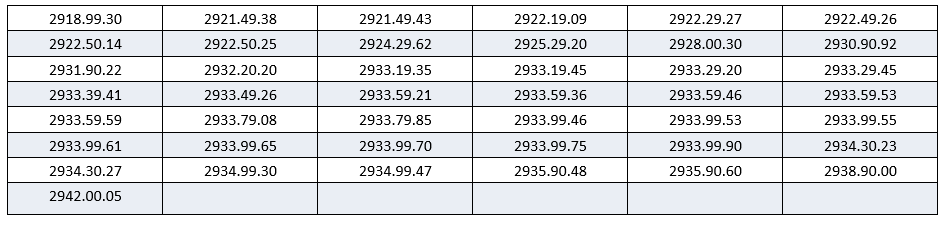
The following 43 eight-digit Chapter 29 headings appear both among the Section 232 covered classifications and on the Section 301 forced labor pharmaceutical-use exemption list (heading 9903.05.89 / U.S. note 52(e)). Listed at the eight-digit level; specific ten-digit statistical suffixes and the pharmaceutical-use condition should be confirmed against the operative Forced Labor HTS List for each entry.