President Trump Invokes Section 338 to Impose 50% Tariffs on Certain Canadian Goods
Background
On July 20, 2026, President Trump signed three proclamations imposing an additional 50 percent ad valorem duty on specified baskets of Canadian-origin goods. The duties apply to goods entered for consumption, or withdrawn from warehouse for consumption, on or after 12:01 a.m. Eastern time on August 19, 2026. The proclamations invoke Section 338 of the Tariff Act of 1930 (19 U.S.C. § 1338)—a long-dormant provision that never previously used to impose duties—together with 3 U.S.C. § 301 and Section 604 of the Trade Act of 1974 (19 U.S.C. § 2483).
Section 338 authorizes the President to impose additional duties of up to 50 percent ad valorem when the President finds that a foreign country imposes an unreasonable charge, exaction, regulation, or limitation that is not equally applied to like articles from other countries or otherwise discriminates against U.S. commerce in a way that disadvantages it relative to another country’s commerce. Duties imposed under the statute may not take effect until at least 30 days after proclamation. Each of the three proclamations uses the maximum authorized duty rate on the shortest permitted timeline.
The proclamations cite three different Canadian measures: provincial liquor-board bans on U.S. alcoholic beverages, USMCA cheese TRQ allocation rules, and Canada’s 2025 motor vehicle surtax and TRQ regime. Despite those different factual predicates, the remedy is the same in each action: a 50 percent additional duty on the Canadian-origin goods identified in Annex II to the relevant proclamation, implemented through three new Chapter 99 headings and a new U.S. Note 51 to Subchapter III of Chapter 99.
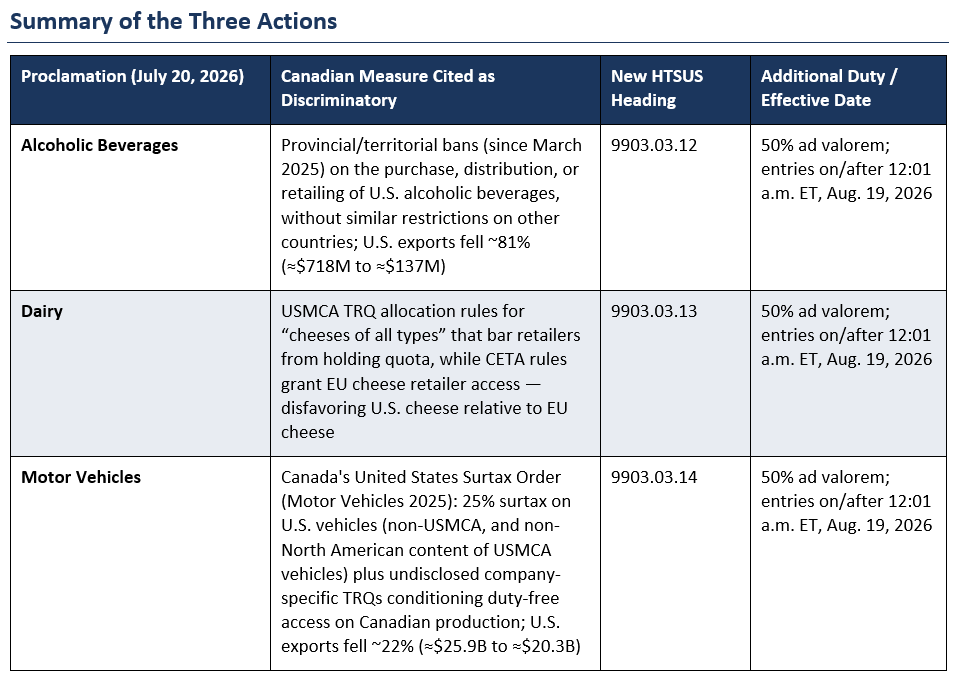
Importantly, the covered product baskets do not align with the sectors in which Canada’s discrimination is alleged. The “alcohol” proclamation, for example, reaches paper products and hockey equipment, while the “motor vehicle” proclamation does not cover motor vehicles because light-duty vehicles remain subject to Section 232. Instead, the motor vehicle action covers a broad basket of roughly 370 tariff subheadings, including cement, apparel, consumer electronics, furniture, sporting goods, boats, and works of art. Scope therefore turns on the Annex II subheading lists—not product labels, sector descriptions, or commercial intuition.
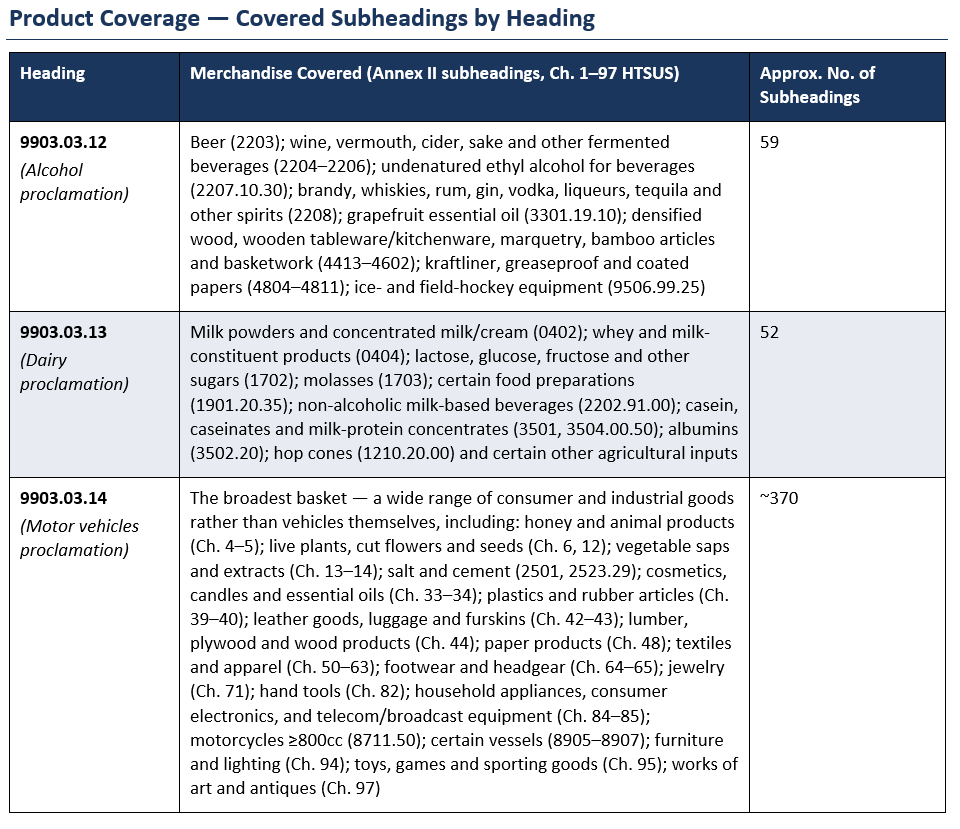
The complete subheading lists appear in Annex II to each proclamation (alcohol: 59 subheadings; dairy: 52 subheadings; motor vehicles: approximately 370 subheadings). Annex I to each proclamation provides informational product descriptions that do not define the scope of coverage; classification questions are directed to CBP. Importers should screen their Canadian-origin entry data against the full Annex II lists at the 8-digit level.
Key Compliance Features
- USMCA origin provides no shelter. The duties apply to all covered goods of Canada regardless of whether the goods qualify for USMCA preferential treatment. Special-rate-eligible and Chapter 99 subchapter II temporary-provision goods are likewise covered except as noted above.
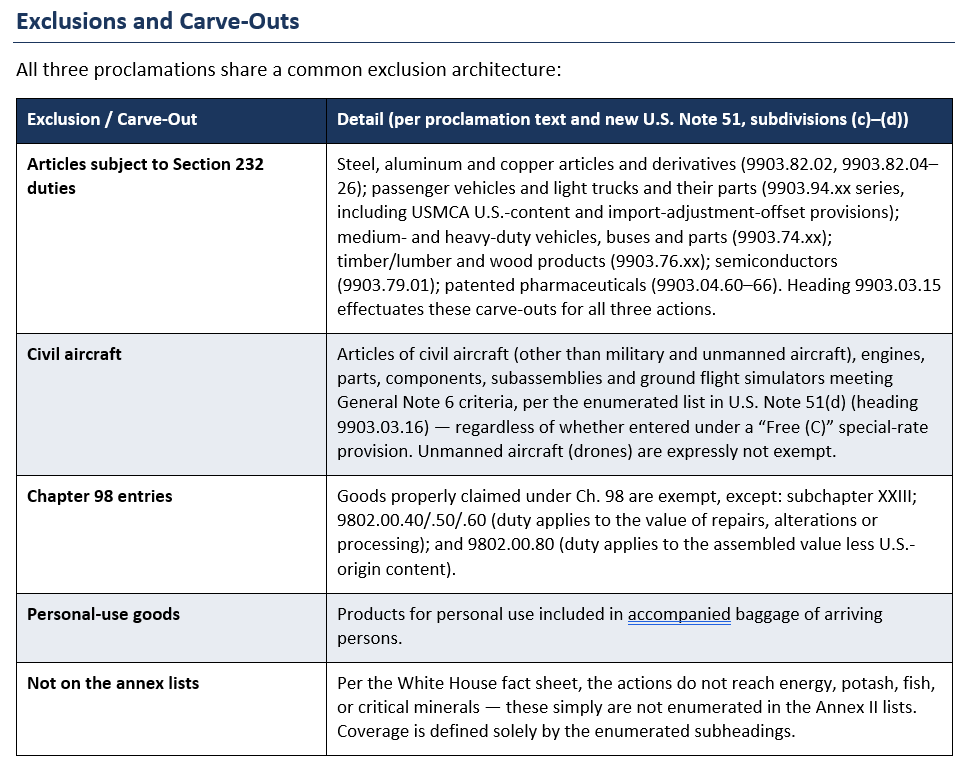
- Full stacking. The 50 percent duty is in addition to the general Chapter 1–97 rate and, except as provided in U.S. Note 51(c)–(d), in addition to any other Chapter 99 Subchapter III or IV duties (e.g., IEEPA and Section 301 measures). Covered goods also remain subject to antidumping and countervailing duties, taxes, and fees.
- FTZ admissions. Covered merchandise admitted to a U.S. foreign trade zone on or after August 19, 2026, must be admitted under privileged foreign status (19 C.F.R. § 146.41), locking in duty treatment at admission; zone entry will not avoid the duty.
- Warehouse withdrawals are captured. The duty attaches to goods withdrawn from bonded warehouse for consumption on or after the effective date, so pre-effective-date warehousing does not preserve current rates.
- Escalation and off-ramps built in. Section 338 permits the President to suspend, revoke, supplement, or amend the proclamations at any time — and, if Canada maintains or increases the discrimination, to exclude Canadian articles from entry altogether (i.e., an import ban). The 30-day window before the effective date leaves room for a negotiated resolution.
- Implementation details to follow. CBP is authorized to issue implementing rules and guidance and to make technical corrections to the annexes via Federal Register notice. Importers should expect CSMS messaging and possible annex refinements before August 19.
Implications for Importers
Companies importing Canadian-origin merchandise should immediately (1) run their entry data against the three Annex II subheading lists to quantify exposure; (2) evaluate entry timing, including accelerating entries or warehouse withdrawals ahead of August 19; (3) confirm whether covered products are instead subject to Section 232 measures (which take precedence and carry different — in many cases lower — rates); (4) revisit valuation, including first sale and assists, given the 50 percent multiplier on entered value; (5) review FTZ admission strategy in light of the privileged-foreign-status mandate; and (6) assess origin, since the duties attach to goods of Canada and sourcing or substantial-transformation shifts may alter exposure. Because Section 338 has never before been used to impose duties, legal challenges to the proclamations are likely, and importers should take action to preserve their rights on affected entries.
A&M's Global Trade practice is monitoring the Federal Register publication, CBP implementing guidance, and any Canadian response, and can assist with exposure modeling, entry strategy, and duty-mitigation planning.