Most transformations begin with the same invisible hurdle: denial that sets in because of anxiety and risk, whether real or perceived. The first step, therefore, is psychological in nature.
When denial takes over, leaders abandon transformation efforts altogether or launch insufficient initiatives with underpowered processes.
This roadblock takes place at the highest level: the CEO, the C-Suite, the Board, resulting in a “Leadership Paradox”: it is the leaders – not middle management – who are the main impediment to a transformation.
Driving a transformation requires psychological courage.
But when well-articulated and well-framed —to stakeholders, and to our internal psyche — a transformation becomes an exciting undertaking, a competitive weapon, arming the organization to face its next horizon.
The question isn't whether your organization will face a transformation. The question is whether you'll lead it to achieve competitive advantage.
How can leaders move from contemplation to action?
Read the full article
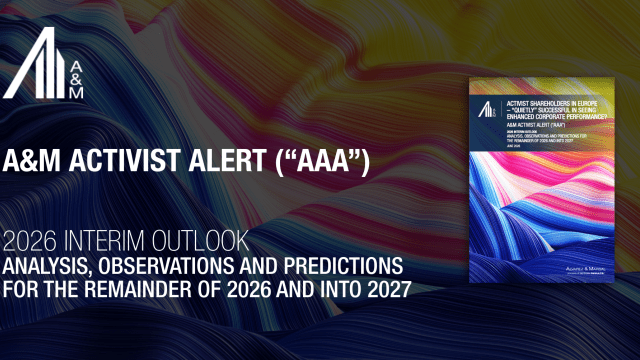
A&M Activist Alert for Europe | Interim 2026 Report
June 29, 2026
As European corporates navigate economic uncertainty, shifting capital allocation priorities, rapid advances in artificial intelligence and increasing scrutiny of strategic decision-making, shareholder activism continues to evolve. While public campaigns remain an important tool, activist investors are increasingly seeking to influence boards behind closed doors, applying pressure privately while remaining ready to wield the “big stick” of acting publicly when necessary.
European A&M Activist Alert
June 29, 2026
Shareholder activism has become one of the most influential forces shaping corporate strategy, capital allocation and value creation across Europe. In an environment where investors are increasingly willing to challenge management teams and boards, understanding activist priorities has never been more important.
Activist pressure starts with underperformance
June 18, 2026
Shareholder activism is accelerating, and the root cause is consistent: sustained operational underperformance relative to peers. In a feature for CFO.com, A&M Managing Director Ron Orsini outlines a more disciplined path: close performance gaps early, build a credible value creation plan, and retain control of your strategy before activists define it for you.
Jay Frankl and Annie Peabody featured in The Deal’s Activist Investing Today Podcast
June 11, 2026
Jay Frankl and Annie Peabody discuss current M&A activism trends in The Deal’s Activist Investing Today podcast, highlighting insights from A&M’s US Activist Alert (AAA) report.