Enterprise Management Incentive Plans - Recent Changes and Common Pitfalls
Overview
Enterprise Management Incentive (EMI) option plans have been at the centre of UK employee incentivisation for many years and remain popular with privately owned, fast-growing companies. They offer a flexible way to reward and retain key employees and, when HMRC statutory conditions are satisfied, can deliver more favourable tax outcomes than many non-tax-advantaged arrangements.
From 6 April 2026, EMI plans became available to a wider group of companies following legislative changes that increased certain qualifying thresholds. In practice, this means many scale-ups and mid-sized companies that previously did not qualify for EMI options may now qualify for this tax-advantaged plan.
In this publication, we consider what the April 2026 changes mean in practice and highlight key qualifying conditions that still need to be satisfied. We also set out common errors and pitfalls that we increasingly see when reviewing EMI arrangements as part of transaction due diligence, which can lead to unintended tax outcomes and price adjustments for the shareholders.
EMI Plans – Qualifying Conditions
EMI options allow companies to incentivise and retain employees by granting options over company shares on a tax-favourable basis, provided various legislative requirements are met. Their flexibility often allows them to be tailored to a company’s commercial objectives more easily than other UK tax-advantaged employee share plans.
Broadly, if a qualifying EMI option is granted at no less than the market value of the underlying shares on the grant date, there should be no income tax or National Insurance contributions (NICs) at grant or on exercise. Instead, the employee is generally taxed only when the shares are ultimately sold, with the growth in value falling within the capital gains tax regime. Furthermore, subject to the relevant conditions, Business Asset Disposal Relief may also be available, further reducing the effective capital gains tax rate on qualifying gains. The employing company can usually obtain a corporation tax deduction by reference to the employee’s gain.
The following illustrative example compares the tax treatment of EMI options and non-EMI (unapproved) options, assuming the options are granted when the tax market value is £2 per share and are exercised and sold three years later, when the value has increased to £10 per share. The tax rates assume the employee is an additional rate taxpayer.
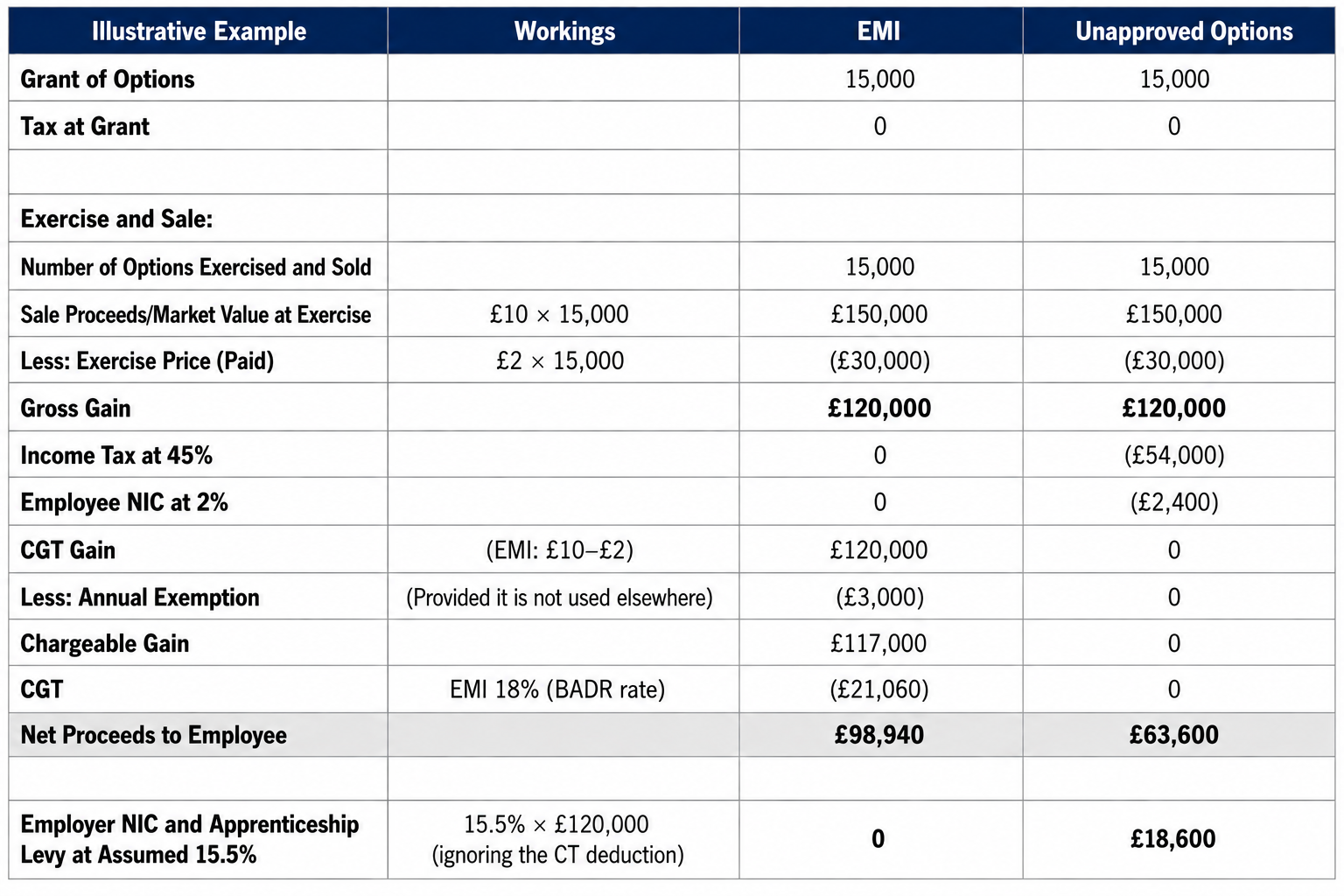
Given these benefits, it is unsurprising that EMI remains by far the most widely used UK tax-advantaged, share-based arrangement for growth companies.
That position is likely to strengthen further following the widening of the regime effective 6 April 2026, when several key qualifying limits were increased to bring more growing businesses within scope.
The principal changes include the following:
- The limit on the total value of company options increased from £3 million to £6 million.
- The gross assets threshold increased from £30 million to £120 million.
- The maximum number of full-time equivalent employees the group can have increased from 250 to 500.
In addition, the maximum exercise period for EMI options has been extended from 10 years to 15 years. This change can also be relevant for existing options that have not lapsed, expired, or been exercised. However, companies should not assume the benefit applies automatically in every case: plan rules and individual option agreements may need to be reviewed and, where appropriate, amended so the legal documentation properly reflects the extended exercise window.
These changes should allow more mid-sized and scaling companies either to implement EMI arrangements for the first time or, in some cases, to continue using EMI for longer as they grow.
That said, widening of the qualifying thresholds does not remove the technical complexity of the EMI legislation, which remains detailed and highly prescriptive. Careful advice is needed both when implementing the EMI plan and throughout the life of the options to ensure that the beneficial tax treatment is achieved.
Common Pitfalls With EMI Plans
We are regularly involved in reviewing EMI plans in the context of acquisitions, investment rounds and pre-exit health checks, and we commonly encounter issues that impact the expected tax treatment.
In our experience, many of these issues arise because important points were missed in the original implementation documents or in the subsequent operation of the plan. If those points are only identified during a transaction, there is often limited scope to fix them at that stage.
Recommendation: Companies should review their EMI arrangements well in advance of any potential transaction and ensure that both the legal documentation and the compliance record support the intended tax treatment.
- EMI Notification Requirement
For EMI options to benefit from the tax-advantaged regime, they must be properly notified to HMRC. For options granted on or after 6 April 2024, the notification deadline is now 6 July following the end of the tax year in which the grant is made. Missing that deadline can be fatal: the option will not qualify for EMI tax treatment, meaning the employee is likely to be subject to income tax and employee NICs on exercise, and the company may also have employer NIC exposure. This is therefore one of the most important practical compliance points for any EMI arrangement.
Recommendation: In practice, companies should ensure that:
- Each grant is notified within the relevant timeframe, since failure to notify on time can turn what was expected to be a capital gains tax outcome into an employment income charge of up to 45% income tax plus employee NICs, with potential employer NIC and apprenticeship levy costs for the company.
- Full records are retained to evidence the notification, including screenshots, acknowledgement numbers, and supporting grant data, because HMRC’s system does not generally provide an easily retrievable record of the details submitted.
This is an area where we frequently see problems in due diligence. In some cases, the company cannot evidence that notification was made at all; in others, the company may have notified but retained no supporting records. Both situations can create uncertainty and, in more difficult cases, may lead companies to consider canceling and re-granting options, which is rarely ideal.
A related practical point is that some legacy plan rules and option agreements still refer to the historic 92-day notification deadline.
Recommendation: These documents should be reviewed carefully. If plan wording suggests that a failure to notify within 92 days causes the option to lapse or lose tax-advantaged status, the drafting may no longer reflect the current law and could create unnecessary uncertainty.
- Independence Condition
To grant qualifying EMI options, the relevant company must satisfy the independence requirement. Broadly, it must not be a 51% subsidiary of another company, nor otherwise be under the control of another company or of another company together with a connected person.
Meeting the condition at the grant date is not sufficient. There must also be no arrangements in place under which the condition will cease to be satisfied.
This means, among other things, that in a group structure the options generally need to be granted over shares in the parent company. It is also important to review the company’s constitutional documents, shareholders’ agreements, and any side arrangements to determine whether another party may already have or be treated as having, control for EMI purposes.
The concept of ‘arrangements’ is broad and can extend beyond a binding sale and purchase agreement. Depending on the facts, it may include heads of terms, a letter of intent, or other documents that evidence a sufficiently developed understanding between buyer and seller. By contrast, a preliminary offer from a prospective purchaser will not normally amount to arrangements until there is mutual understanding between the parties.
Recommendation: Where a sale process is underway, the timing of any EMI grant must be considered very carefully. Once a sufficient mutual understanding exists in relation to the sale, EMI options granted after that point may fail to qualify.
- Valuation of Shares Under the Option
EMI options can be granted with an exercise price being below the tax market value of the shares on the grant date, but in most cases the exercise price is set to be equal to the tax market value to ensure there is no income tax charge on exercise.
Although obtaining HMRC agreement to the share valuation is not mandatory, it is generally highly advisable. An agreed valuation gives the company and option holders greater certainty over the tax treatment, and it also helps the company test the individual (£250,000 per individual) and overall EMI limits.
Where HMRC agrees a valuation, that agreement is generally valid for 90 days from the agreement date, provided there has been no change in the company’s circumstances that could affect value before the options are granted.
It is important to note the following:
- An EMI valuation agreed with HMRC is for EMI purposes only; it should not be assumed that the same valuation can safely be used for other tax, accounting, or commercial purposes.
- The 90-day validity period is conditional. If a material event occurs before grant, for example, a funding round, a significant commercial development, or a credible offer to acquire the company, the earlier valuation may no longer be reliable, and a fresh submission may be required.
We often see EMI options granted relatively close to an exit event. That can be particularly sensitive. Even if the company still meets the EMI qualifying company tests, it is essential to consider how the proposed transaction affects the share value, whether the existing valuation remains supportable, and whether the valuation submission properly discloses all the relevant facts.
- Use of Board Discretion
It was previously common practice to use Board discretions permitted within the plan rules to allow options to become exercisable, for example, on a partial exit event or where no exit was achieved within the initially intended 10-year period. However, following updated [1], which clarified HMRC’s position on the use of discretion, we now see only limited cases in which the use of discretion would not affect the qualifying treatment.
Recommendation: The use of Board or Remuneration Committee discretion needs to be considered carefully in the EMI context. HMRC’s current guidance makes clear that, in certain circumstances, exercising discretion can amount to a substantive variation of the option terms. If that happens, the original option may be treated as having been released and re-granted, which can jeopardise the expected tax treatment. This is particularly relevant where the discretion affects when the option becomes exercisable, the vesting conditions, or other fundamental terms.
- Leavers and 90-Day Window, Changes in Work Patterns
Leaver provisions are another area that frequently creates problems in practice. Many EMI plans provide that options become exercisable for a limited period following cessation of employment and then lapse. From a tax perspective, however, cessation of employment is a disqualifying event. If an option is not exercised within 90 days of that event, part of the gain may be taxed as employment income rather than as a capital gain.
Companies also need to monitor changes in working patterns. An employee who no longer meets the EMI working time requirement may trigger a disqualifying event even if they remain employed.
Recommendation: EMI plans need to be administered on an ongoing basis, particularly where employees move to part-time arrangements, change roles, transfer internationally, or otherwise alter their working pattern.
- Granting EMI Options to Employees Who Are Taxpayers in Other Countries
Granting EMI options to employees who are, or may become, subject to overseas taxation can raise a separate set of issues. EMI is a UK tax-favored regime and does not override the tax treatment in other countries, so if employees work across multiple jurisdictions or move abroad after the grant of their EMI options, specialist cross-border tax advice should be sought.
We also often see cases where UK companies grant EMI options to UK employees who are also taxed in the US, for example, because they live in the UK but are US nationals or US green card holders.
Recommendation: In such cases, UK companies should consider whether the option pricing and documentation are compatible with US section 409A requirements. A valuation agreed with HMRC for EMI purposes would generally not satisfy US valuation requirements, and a separate US-focused analysis will be needed before grant to avoid unintended tax implications.
Conclusion
The expansion of the EMI regime from 6 April 2026, is a welcome development and should make the plan available to a broader range of growing businesses. However, changes to the qualifying thresholds do not reduce the importance of careful implementation and ongoing administration.
In our experience, many issues identified during transaction due diligence arise not because EMI is inherently unsuitable, but because relatively straightforward requirements have been overlooked in the documentation, valuation process, or day-to-day operation of the arrangement, or because the documentation itself has been poorly drafted. Companies that review their EMI arrangements regularly, keep robust records, and seek advice before key corporate events will be better placed to preserve the intended tax treatment and avoid unnecessary issues later in a transaction process.
Key Takeaways
- Effective 6 April 2026, EMI became available to a wider range of companies due to increase in the gross assets, employee number, and overall option value thresholds.
- The extension of the maximum EMI exercise period from 10 years to 15 years may require existing plan rules and option agreements to be reviewed.
- The most common due diligence issues often relate to HMRC notification, evidencing compliance, valuation assumptions, the independence condition, and the treatment of disqualifying events.
- EMI arrangements should be monitored throughout their life, rather than only when a transaction is imminent.
- Early review and remedial action can significantly reduce execution risk in a sale, investment, or other corporate transaction.
If you would like to discuss any of the issues raised in this article or would like to find out how A&M Tax can assist you with Enterprise Management Incentive Plans, please contact Louise Jenkins or Anna Turner.
[1] [ARCHIVED CONTENT] Employment Related Securities Bulletin 46 (October 2022) - GOV.UK