A look into trends in the evolving EV market
This edition of the Automotive Industry Spotlight will focus on trends in the electric vehicle (EV) market.
In industry news:
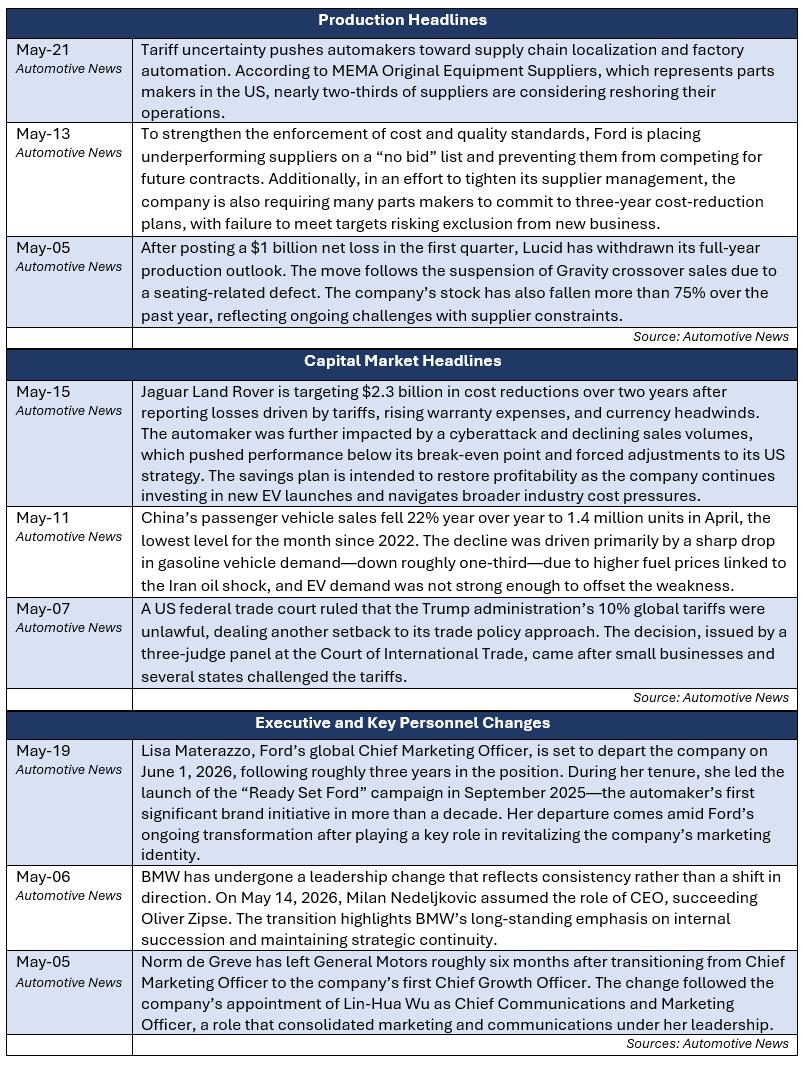
- Lucid Motors Withdraws Production Outlook – Following a $1 billion net loss in Q1, Lucid Motors withdrew its full-year production outlook.
- Jaguar Land Rover Cost Savings Initiative – Jaguar Land Rover announced it will be targeting $2.3 billion in cost savings over the next two years as the automaker navigates impacts from tariffs and broader market headwinds.
- Leadership Departure – Ford’s global chief marketing officer, Lisa Materazzo, is set to leave the automaker on June 1, 2026.
In regulatory news:
- Vehicle Safety Costs – Rising car prices are driven more by consumer preferences for larger vehicles, with safety technology playing a smaller role.
- United States-Mexico-Canada Agreement (USMCA) Review Outlook – The agreement faces its first scheduled review on July 1, with rules of origin, labor requirements, and even the review framework itself under scrutiny.
- EV Annual Road Repair Fees – A bipartisan House bill proposed annual fees on EVs to fund road repairs to address lost fuel tax revenue as EV adoption grows.
Industry Focus: Recalibrating EV Strategies
After several years of aggressive electrification investment and ambitious EV rollout targets, automotive manufacturers are increasingly adopting more balanced production strategies as market conditions continue to evolve. While EV adoption remains central to long-term industry strategy, softer demand growth, affordability concerns, and continued charging infrastructure limitations have led many original equipment manufacturers (OEMs) to reassess the pace and structure of their transition plans. Rather than moving away from electrification altogether, the industry appears to be shifting toward a more measured approach that’s focused on aligning production with near-term consumer demand.
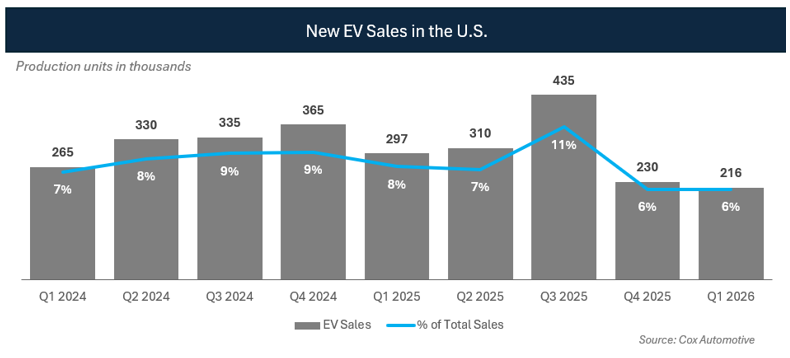
Several OEMs have already begun adjusting production strategies accordingly. Hybrid and plug-in hybrid demand has continued to accelerate across several major markets even as EV adoption trends remain uneven. Toyota recently increased planned hybrid and plug-in hybrid production targets amid continued demand growth, reflecting the industry’s broader emphasis on more balanced powertrain portfolios alongside ongoing EV investment initiatives. [1] At the same time, manufacturers increasingly appear focused on maintaining flexibility within production footprints, allowing facilities to support multiple powertrain configurations as consumer demand continues to evolve.
Diversification and Manufacturing Optionality
Beyond adjustments to vehicle production mix, some manufacturers are also evaluating broader ways to leverage existing manufacturing capacity and engineering capabilities. A recent Wall Street Journal report highlighted preliminary discussions between the Pentagon and several OEMs regarding the potential use of excess automotive manufacturing capacity for defense-related production support. [2] While discussions remain in the early stage, the development underscores the strategic value of flexible manufacturing infrastructure as portions of the industry manage evolving production utilization levels.
More broadly, the discussions reflect how OEMs may increasingly explore adjacent industrial opportunities that can leverage existing supply chains and large-scale manufacturing capabilities. Although passenger vehicle production remains the industry’s primary focus, diversification initiatives may become increasingly relevant as manufacturers continue balancing EV investment requirements with fluctuating consumer demand trends.
China’s EV Advancement Remains a Long-Term Competitive Consideration
At the same time, continued advancements in China’s EV market remain a significant competitive consideration for global automakers. Chinese manufacturers such as BYD have continued gaining global market share through advancements in battery technology, lower-cost vehicle production, rapid scaling capabilities, and ongoing investments in ultra-fast charging technology intended to reduce charging times and improve EV convenience. [3]
While Chinese EVs currently face substantial regulatory and geopolitical barriers limiting direct access to the US market, continued advancements in affordability, charging capabilities, and manufacturing efficiency continue pressuring traditional OEMs to accelerate innovation while balancing profitability concerns. As a result, the global EV transition increasingly appears shaped not only by consumer adoption trends but also by intensifying international competition.
Overall, the automotive industry continues to navigate a complex and evolving phase of electrification. While EV investment remains an important component of long-term industry strategy, manufacturers increasingly appear focused on balancing electrification goals with production flexibility, profitability, and shifting consumer demand trends as the competitive landscape continues to develop.
Sources
[1]. Reuters: Toyota plans 30% boost to 2026 hybrid vehicle output by 2028
[2]. WSJ: Pentagon Approaches Automakers, Manufacturers to Boost Weapons Production
[3]. Reuters: BYD doubles down on fast charging to target China's EV holdouts
Additional insights are included below.
Industry Update
April inventory levels remained relatively stable at approximately 2.9 million units, while industry days’ supply declined slightly month-over-month to 78 days from 79 days in March. The more balanced inventory environment follows elevated days’ supply readings earlier in the year and reflects a steadier sales pace entering the spring selling season. However, compared to April 2025, days’ supply remains meaningfully higher, largely due to the stronger tariff-driven demand conditions experienced last year.
The underlying mix across price points and vehicle segments also continues to normalize gradually. Average listing prices increased to approximately $49,025 in April, representing a 0.9% increase from March levels and a 1.3% increase year over year, remaining relatively stable compared to historical pricing trends. The modest pricing movement suggests automakers continue balancing disciplined inventory management with ongoing affordability pressures and softer consumer demand conditions. Incentive activity also appears increasingly concentrated around specific vehicle segments and aging inventory while pricing on newer inventory has generally remained relatively stable. [1]
Sources
[1]. Cox Automotive: New-Vehicle Inventory Holds Steady in April as Automakers Sell Down Model Year 2025 Inventory
Regulatory Landscape
Drivers of Vehicle Pricing: Despite increasing concerns around vehicle affordability, experts say safety features are not the primary driver behind rising car prices. Instead, higher costs are largely attributed to consumer demand for larger, more expensive vehicles as well as broader market dynamics such as the decline of entry-level models. While automakers continue to add advanced safety technologies, these features are typically introduced in higher-end models before gradually scaling to mainstream vehicles to manage costs. At the same time, innovations such as internal monitoring systems represent the next frontier in safety, though they bring new considerations around data privacy. Overall, industry experts emphasize that safety and affordability are not inherently at odds, with safety advancements delivering significant value relative to their cost. [1]
USMCA Uncertainty: The USMCA faces its first scheduled review on July 1, creating uncertainty around the future of the North American auto trade. Key provisions under discussion include rules of origin, labor requirements, and the structure of the agreement’s review process, with stakeholders pushing for updates to better reflect EVs and advanced technologies. Labor groups are also advocating for stricter wage standards while industry participants are focused on maintaining stability amid broader trade disruptions. The outcome of the review could either reinforce long-term certainty or introduce further complexity, with significant implications for investment, supply chains, and competitiveness across the region. [2]
Lawmakers Target EVs with New Road Funding Fee Proposal: A bipartisan House bill proposed a $130 annual fee on EVs and a $35 annual fee for plug-in hybrids to help fund road repairs, addressing the gap created by the lack of gasoline taxes paid by EVs. The fees would increase gradually starting in 2029 and are part of a broader five-year, $580 billion highway funding package under consideration. The proposal has sparked debate, with critics arguing the fees could discourage EV adoption and unfairly burden owners compared to gasoline vehicle taxes. The legislation also includes provisions to establish federal safety standards for autonomous commercial vehicles, signaling broader regulatory focus alongside funding changes. [3]
Sources
[1]. Safety features have limited role in car affordability crisis - Automotive News
[2]. USMCA review has best- and worst-case-scenarios for auto industry - Automotive News
[3]. House bill proposes $130 annual EV fee for road repairs - Automotive News
Stay connected to industry financial indicators and check back in June for the latest Auto Industry Spotlight.
Automotive Industry Spotlight Archive