A look into trends in excess EV manufacturing capacity and energy storage markets
This edition of the Automotive Industry Spotlight will focus on automotive-related developments in the energy storage market.
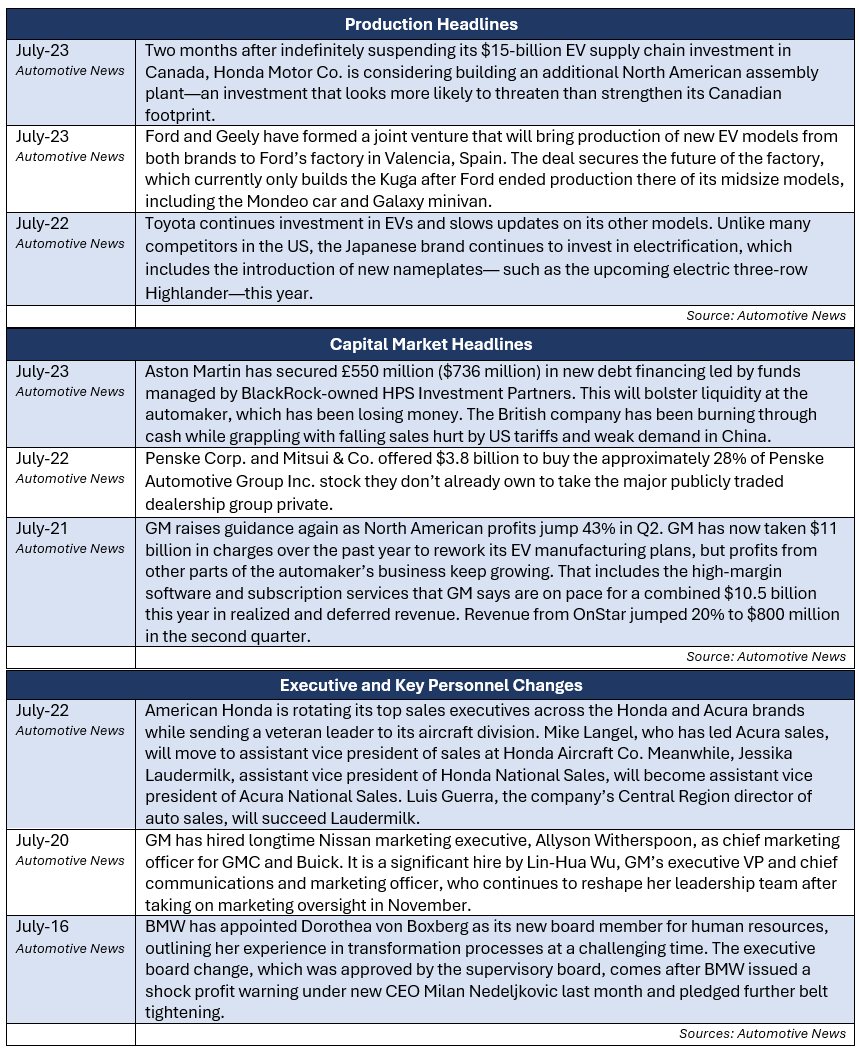
In industry news:
- Honda North American Production Strategy – Honda is evaluating a new North American assembly plant while reassessing its electric vehicle (EV) manufacturing footprint, signaling continued efforts to optimize production capacity amid shifting demand.
- Aston Martin Liquidity – Aston Martin secured $736 million in new financing to strengthen liquidity as the company continues to navigate weak demand and tariff-related pressures.
- General Motors (GM) Marketing Leadership – GM appointed Allyson Witherspoon as chief marketing officer for GMC and Buick, continuing broader organizational changes within its marketing leadership team.
In regulatory news:
- State Privacy Regulations – Automakers face growing compliance challenges as a patchwork of state privacy laws complicates the collection, use, and protection of connected vehicle data.
- Defense Manufacturing Opportunities – Rising global defense spending is creating new opportunities for automakers to diversify by leveraging existing manufacturing capabilities for military production.
- Autonomous Vehicle Regulations – The US Department of Transportation is proposing updates to federal safety standards that could accelerate the deployment of purpose-built autonomous vehicles by removing outdated design requirements.
Industry Focus: From EV Batteries to Grid Power
As EV demand softens, automakers including Ford and GM are beginning to repurpose excess manufacturing capacity originally built for EVs into stationary energy storage systems for various use cases. Automotive suppliers are equally recognizing the opportunities driven by AI data center buildouts and grid modernization and are pursuing adjacent initiatives that leverage their manufacturing and engineering capabilities.
Manufacturing Capacity and Demand
US automakers and battery suppliers have scaled back EV ambitions and are redirecting excess battery capacity toward rapidly growing energy storage markets as demand shifts and battery energy storage system (BESS) markets accelerate. Stranded capacity and idle manufacturing footprints represent sunk costs, but energy storage demand offers an alternative avenue for realizing returns on prior EV investments. GM and LG are transforming an EV battery plant in Tennessee to produce lithium-iron phosphate batteries for energy storage systems, recalling 700 laid-off workers to begin production in 2026. [1]
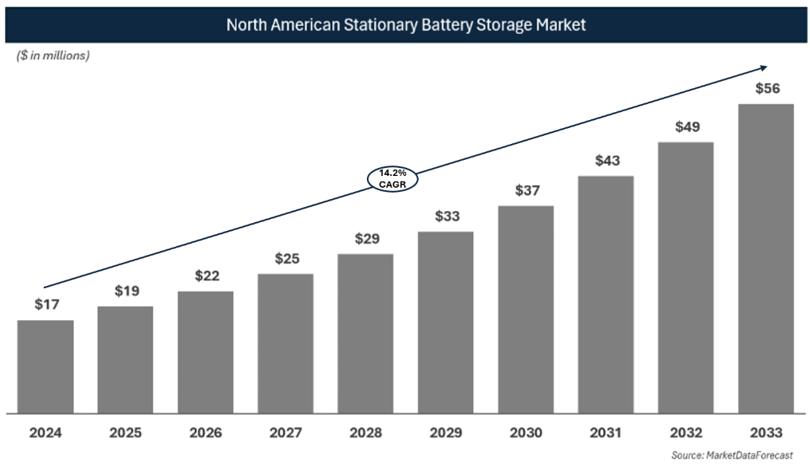
Strategic Approaches
Automakers are taking different paths to market entry. Ford launched Ford Energy with a $2 billion investment, repurposing EV batteries for stationary energy storage across utilities, AI data centers, and industrial customers. The investment comes alongside a five-year supply agreement with EDF Power Solutions, targeting up to four gigawatt hours of annul battery storage beginning in 2028. [2] This approach leverages existing battery technology and manufacturing processes, prioritizing speed to market and quick revenue generation.
Conversely, GM announced its GM Energy division expansion into grid-scale storage, partnering with Peak Energy to develop sodium-ion battery cells for utility and data center applications. With initial deliveries expected post-2028, GM is making a big bet on sodium-ion batteries. This technology isn't well-suited for cars but is ideal for stationary storage connected to utility grids and data center installations, with technology expected to be 20%–25% cheaper than other systems that use repurposed EV batteries. [3]
While automakers focus on battery technology repurposing, automotive suppliers and battery manufacturers are pursuing adjacent energy opportunities that draw on specialized engineering capabilities. BorgWarner signed a master supply agreement with TurboCell to supply a modular turbine generator system designed for data center power generation. The system leverages BorgWarner's core competencies in turbocharging, thermal management, power electronics, and advanced software controls, and is expected to begin production in 2027 at a facility in Hendersonville, North Carolina. [4] Similarly, Our Next Energy, a Michigan-based battery company, paused its automotive EV investments to redirect its manufacturing footprint toward rail, defense, and utility-scale energy storage systems to enhance US infrastructure resilience. These moves reflect a broader recognition that certain skills and infrastructure built for automotive electrification readily transfer to stationary energy applications.
Moving Forward
Following substantial EV write-downs this year, automakers are confronting manufacturing capacity designed for a market that is materializing much slower than originally expected. Energy storage represents a near- and long-term outlet for assets that would otherwise remain idle. As other original equipment manufacturers and suppliers encounter similar excess capacity challenges, expect additional examples of how automotive-grade engineering and manufacturing capabilities can address adjacent market needs.
Sources
[1]. Reuters: GM, LG retool Tennessee battery plant for energy storage batteries, recall laid-off workers
[2]. Reuters: Ford unit signs five-year energy storage deal with EDF
[3]. Axios: GM bets bigger on battery storage
[4]. BorgWarner: BorgWarner Strategically enters data center market with power generation solution award
Additional insights are included below.
Industry Update
June new-vehicle inventory remained relatively stable at approximately 2.8 million units, down modestly from May but largely unchanged compared to the prior year. Industry days' supply increased to 80 days, up from 78 days in May, primarily reflecting a slower sales pace. Overall, inventory levels continue to suggest a well-balanced market, with automakers generally maintaining disciplined production and inventory management.
The underlying mix across price points also remains constructive. Average listing prices increased modestly to approximately $49,336, representing a 0.3% increase month over month and 1.4% growth year over year. While the average transaction price remains near $50,000, inventory continues to be concentrated in the more affordable $30,000–$40,000 price range, which accounts for roughly 24% of available inventory and continues to experience below-average days' supply due to healthy consumer demand. Overall, June's inventory data suggests the market remains well balanced, with healthy sales, manageable inventory levels, and affordability challenges driven more by broader economic conditions than by vehicle pricing. [1]
Sources
[1]. Cox Automotive: June New-Vehicle Inventory Holds Steady as Sales Pace Cools
Regulatory Landscape
State Privacy Regulations: As connected vehicles generate increasing amounts of consumer data, automakers are facing a more complex regulatory landscape driven by a growing patchwork of state privacy laws. In the absence of a federal privacy framework, manufacturers must navigate varying state requirements governing data collection, consumer consent, and data protection, making nationwide compliance increasingly challenging. While many automakers have historically adopted a single nationwide privacy standard, diverging state regulations are making that approach more difficult, prompting increased investment in privacy compliance and renewed industry support for a uniform federal privacy law. [1]
Defense Manufacturing: As global defense spending accelerates, automakers are increasingly exploring opportunities to leverage their advanced manufacturing capabilities in support of military production. While defense programs offer a compelling avenue for revenue diversification amid broader industry challenges, manufacturers must navigate a highly specialized landscape of government contracting, certification requirements, and compliance standards. Industry experts suggest automakers will likely focus on producing vehicles and components that align closely with existing manufacturing capabilities, allowing them to capitalize on growing defense demand while minimizing operational complexity. [2]
Autonomous Vehicle Regulations: The US Department of Transportation is proposing updates to federal vehicle safety standards that would eliminate the requirement for brake pedals in vehicles designed to operate exclusively without a human driver. The proposed change reflects broader efforts to modernize regulations for autonomous vehicles and could reduce a key regulatory barrier for purpose-built robotaxis. While the update may accelerate commercialization for autonomous vehicle developers, widespread adoption will continue to depend on technological maturity, consumer acceptance, and the establishment of a broader federal regulatory framework. [3]
Sources
[1]. Automotive News: Automakers play catch-up with fast-changing state privacy regulations
[2]. Automotive News: Defense budgets are soaring. But automakers’ march to battle comes with risks
[3]. Automotive News: U.S. set to end brake pedal requirements for driverless vehicles
Stay connected to industry financial indicators and check back in August for the latest Auto Industry Spotlight.
Automotive Industry Spotlight Archive