The Evolving State of OEM Parts and Service
This edition of the Automotive Industry Spotlight will focus on the evolving state of original equipment manufacturer (OEM) parts and service.
In industry news:
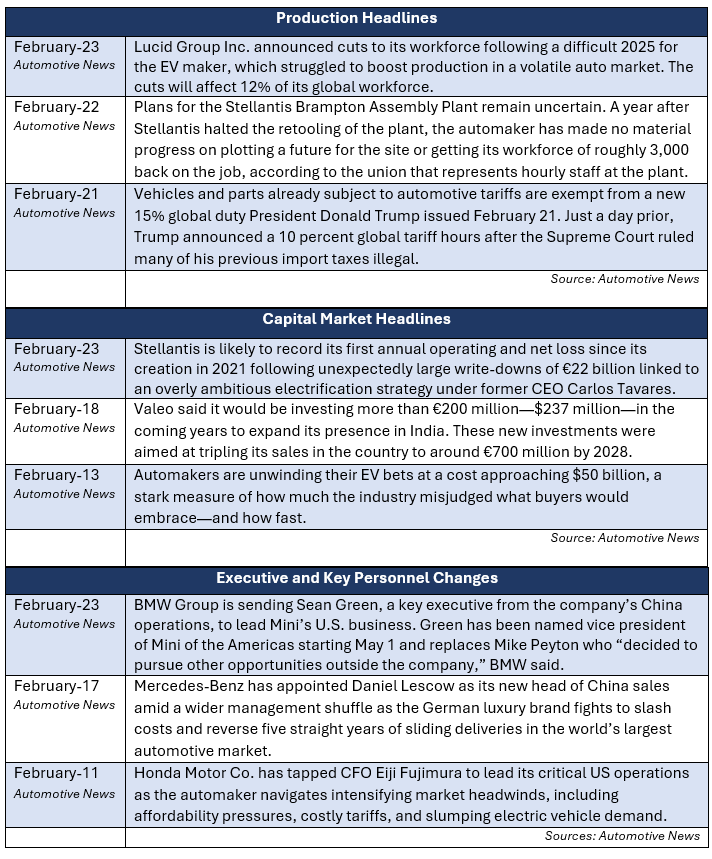
- Workforce reduction – Lucid Group announced an approximate 12% workforce reduction following a difficult 2025.
- Operating and net loss – Stellantis is likely to record its first annual operating and net loss since its creation in 2021.
- Newly appointed CFO – Honda Motor Co. has tapped CFO Eiji Fujimura to lead its critical US operations as the automaker navigates intensifying market headwinds.
In regulatory news:
- Emissions findings repeal – President Trump’s Environmental Protection Agency (EPA) has repealed the agency’s finding that greenhouse gas emissions endanger the public, creating a fresh round of uncertainty for the automotive industry.
- Interior redesigns – European automakers are reworking interior designs amid pressure to bring back physical buttons due to the fear of touchscreen failures.
- Right-to-repair legislation – The National Automobile Dealers Association (NADA) is pushing Congress and the Trump administration to prevent the passage of federal right-to-repair legislation and reduce the automotive industry’s exposure to tariffs.
Industry Focus: Parts and Service
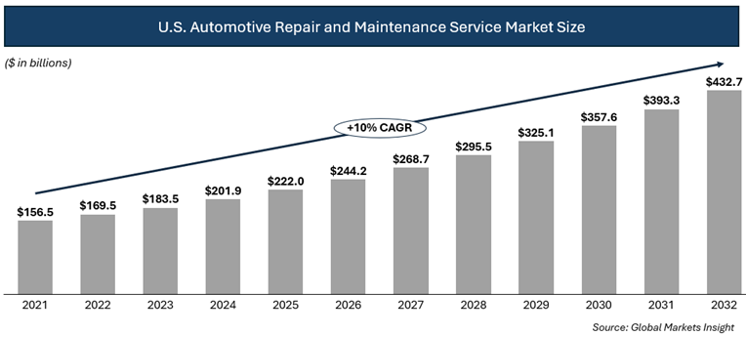
While industry attention often centers on vehicle sales, parts and service revenue remains a foundational component of OEM economics. Beyond the initial vehicle transaction, OEMs participate in recurring revenue streams through genuine parts distribution, warranty programs, extended service contracts, and maintenance ecosystems. These revenue streams tend to be less cyclical than vehicle production and, in many cases, offer higher margins. At the dealer level, parts and service operations frequently represent a disproportionate share of profitability, reinforcing the importance of lifecycle monetization across the broader value chain.
Post-Pandemic Tailwinds
Recent years further underscored this dynamic. Pandemic-related supply constraints extended vehicle ownership cycles and elevated the average age of the fleet, supporting repair and maintenance demand. [1] Even as new vehicle production normalized, fleet age remained historically elevated, providing continued near-term support for parts and service activity. At the same time, OEMs have invested more heavily in customer retention tools, digital scheduling platforms, and connected vehicle infrastructure, reinforcing service as a strategic touchpoint rather than a secondary revenue stream.
Fleet Mix and Revenue Composition
Looking ahead, fleet composition will increasingly shape the mix of service revenue. Internal combustion engine vehicles continue to underpin routine maintenance demand, but gradual electric vehicle (EV) and hybrid penetration introduces a different maintenance profile. While EVs generally require fewer traditional service intervals, they bring new diagnostic-, software-, and battery-related considerations. In parallel, connected vehicle capabilities such as over-the-air updates and subscription-based feature activation create the potential for incremental, technology-driven revenue streams that extend beyond mechanical repair.
Outlook
In the near term, the more relevant question is not whether parts and service revenue will decline, but rather how it will continue to evolve. An aging vehicle base, measured EV adoption, and expanding digital integration suggest that lifecycle revenue will remain central to OEM economics. The composition may shift over time from routine mechanical maintenance toward software-enabled and technology-driven offerings, but the strategic importance of service within the automotive ecosystem is likely to persist.
Source:
[1]. S&P Global: Average Age of Light Vehicles in the US Hits Record High 12.5 years
Additional insights are included below.
Regulatory Landscape
EPA Emissions Finding: President Donald Trump’s EPA has repealed the agency’s finding that greenhouse gas emissions endanger the public, creating a fresh round of uncertainty for the automotive industry. Trump and EPA Administrator Lee Zeldin announced the repeal of the 2009 endangerment finding at a press conference at the White House on Feb. 12. [1]
Touchscreen Reliance: Automakers are being pressured to bring back physical buttons in fear of touchscreen failures. European automakers are reworking interior designs after the European New Car Assessment Programme updated its assessment protocols in January to discourage touchscreen-only controls for essential driving tasks. The move extends a safety debate that intensified as touchscreen-dependent dashboards became standard across the industry. [2]
Transportation Bill: The NADA eyes the upcoming transportation bill as a means to advance its 2026 policy goals. The association is pushing Congress and the Trump administration to prevent the passage of federal right-to-repair legislation and reduce the auto industry’s exposure to tariffs, among other goals, the NADA’s public policy chief said. The upcoming reauthorization of the federal surface transportation bill will be a major point of focus for the NADA, which hopes it can achieve a number of policy goals through the legislation. [3]
Sources:
[1]. Automotive News: Trump EPA kills landmark emissions finding used for vehicle regulations
[2]. Automotive News: Automakers pressured to bring back physical buttons on fear of touchscreen failures
[3]. Automotive News: NADA eyes transportation bill to advance its 2026 policy goals
Stay connected to industry financial indicators and check back in March for the latest Auto Industry Spotlight.
Automotive Industry Spotlight Archive