Renewed Energy Market Volatility and Supply Chain Disruptions
This edition of the Automotive Industry Spotlight will focus on the impacts stemming from geopolitical events driving energy market volatility and supply chain disruptions.
In industry news:
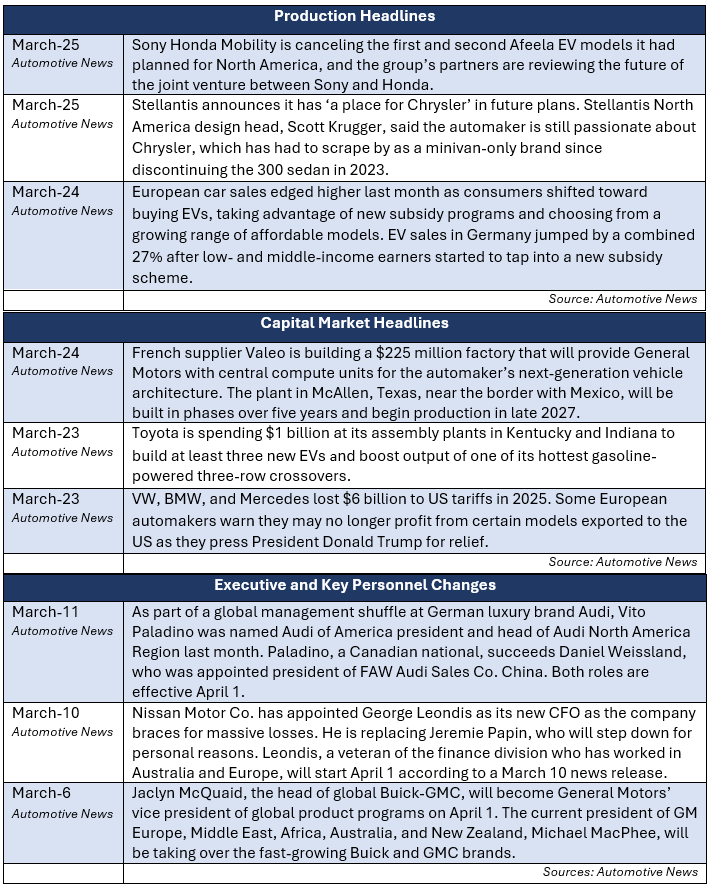
- European car sales – European car sales edged higher last month as consumers shifted toward buying electric vehicles (EVs).
- New $225 million Texas auto factory – Valeo announced plans for a Texas factory that will supply key tech components to General Motors for next-generation vehicle architecture.
- New Audi CEO – Audi named Vito Paladino as president of Audi America and head of the Audi North America Region.
In regulatory news:
- Volkswagen Recall – Volkswagen is recalling nearly 100,000 EVs, citing problems linked to battery modules.
- California Emissions Lawsuit – The Trump administration sued the State of California, claiming its zero-emission vehicle and tailpipe greenhouse gas emission rules are illegal and preempted by federal law.
- Dealership Advertising – Dealership employees who post about vehicles for sale on their personal accounts could put their stores in legal jeopardy if they don’t follow certain rules.
Industry Focus: Energy Markets and Supply Chain Disruptions
Recent geopolitical tensions, including the conflict involving Iran, have renewed focus on the automotive industry’s exposure to external shocks. As impacts continue to develop, the situation highlights a broader dynamic: energy markets and global supply chains serve as key operating variables within the industry, with heightened sensitivity to external factors.
Energy Volatility
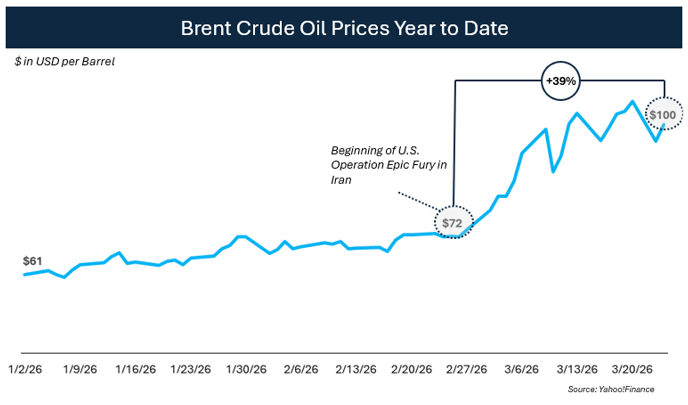
Oil price movements have been the most immediate impact, with uncertainty-driven pressure contributing to recent volatility. For automotive manufacturers and suppliers, this could translate into higher and less-predictable costs across fuel, freight, and energy-intensive production processes. Given the industry’s reliance on petrochemical inputs and global logistics, even modest fluctuations can create meaningful margin pressure, particularly where cost pass-through mechanisms are delayed or constrained.
These pressures also have the potential to cascade into raw materials, including metals and plastics, amplifying cost inflation across the supplier base. Tier 2 and Tier 3 suppliers are particularly exposed given their limited pricing power and less flexible contractual structures. As a result, sustained volatility may drive margin compression and incremental financial strain across portions of the supply chain. [1]
Supply Chain Risk
Heightened risk across key trade routes, including the Strait of Hormuz, has increased the potential for shipping delays, rerouting, and higher insurance and freight costs. While supply chains have improved since pandemic-era disruptions, they remain structurally more complex and costly. In a more volatile environment, suppliers may look to increase inventory levels to buffer against variability and potential disruptions.
Recent tariff actions serve as another example of this broader fragility, highlighting how quickly global supply chains can be disrupted and cost structures reset. These dynamics continue to reinforce a supply chain environment characterized by greater complexity, variability, and costs.
Bottom Line
Taken together, recent developments underscore the extent to which external factors are shaping operating conditions across the automotive value chain. For manufacturers and suppliers, this is showing up through increased cost pressure, greater variability across supply chains, and a need to plan around a wider range of potential outcomes. If elevated oil prices are sustained, this could also begin to influence consumer behavior, potentially accelerating interest in EV adoption and adding another layer of complexity to demand planning across the industry.
Source:
[1]. Cox Automotive: Iran Conflict Raises Risks for Energy and Auto Supply Chains
Additional insights are included below.
Industry Update
February inventory levels ended at 2.85 million units, a 114,000-unit increase from January. Days’ supply closed at 92, approximately three days lower year-over year. The month-over-month increase in inventory levels reflects a seasonal pattern as dealers invest in inventory ahead of spring demand.
February data continues to show a clear bifurcation by price band. Vehicles in the $35,000–$45,000 range remain supply-constrained, with approximately 81 days of inventory and strong demand across brands like Toyota and Honda. In contrast, the $45,000–$55,000 segment remains oversupplied at approximately 120 days, with brands such as Ford and Jeep facing more pronounced inventory pressure, likely driving increased incentives and margin compression. [1]
Source:
[1]. Cox Automotive: February New-Vehicle Inventory: Stable Headlines, Uneven Reality
Regulatory Landscape
Volkswagen EV Recall: According to the German motor vehicle authority KBA, Volkswagen is recalling nearly 100,000 EVs, with approximately 28,000 in Germany alone, citing problems linked to battery modules. The recall notices affect nearly 75,000 vehicles from VW’s ID series as well as nearly 20,000 Cupra Borns that were built between February 2022 and August 2024. According to the notices issued, modules in the high-voltage battery that do not meet specifications can result in reduced range and a risk of fire. [1]
California Emissions Lawsuit: The Trump administration sued the State of California, claiming its zero-emission vehicle and tailpipe greenhouse gas emissions rules are illegal and preempted by federal law. The US Transportation Department sued the California Air Resources Board in a US District Court in California over vehicle rules that remain in place after President Donald Trump signed legislation to overturn the state’s rules that aim to phase out new gasoline-powered cars by 2035. [2]
Dealership Advertising: Dealership advertising has come under intense scrutiny since March 13 when the Federal Trade Commission (FTC) announced Christopher Mufarrige, director of the agency’s Bureau of Consumer Protection, sent letters to 97 dealership groups on the suspicion that they violated at least one of six illegal advertising practices. Additionally, the FTC will treat advertising generated by employees as though it came from the dealership itself. This means that dealership employees who post about vehicles for sale on their personal accounts could put their stores in legal jeopardy if they don’t follow certain rules, such as properly disclosing employment. [3]
Sources:
[1]. Automotive News: VW recalls nearly 100,000 EVs over battery issues
[2]. Automotive News: Trump administration sues California over zero-emission vehicle, greenhouse gas rules
[3]. Automotive News: What dealerships need to know about FTC liability from employees’ personal social media posts
Stay connected to industry financial indicators and check back in April for the latest Auto Industry Spotlight.
Automotive Industry Spotlight Archive