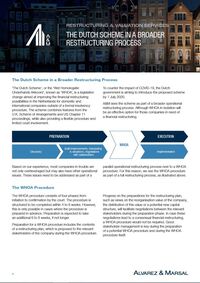
On 11 May, Dutch parliament will decide whether to fast track the introduction of the “Wet Homologatie Onderhands Akkoord’, known as ‘WHOA’ or the Dutch Scheme. The legislation would lead to a major improvement of financial restructuring possibilities in the Netherlands for domestic and international companies outside of a formal insolvency procedure.
If successful, the proposed scheme will be introduced by 1 July 2020 combining features from the U.K. Scheme of Arrangements and US Chapter 11 proceedings, while also providing a flexible procedure and limited court involvement.
Based on A&M’s experience, most companies in trouble are not only overleveraged but may also have other operational issues. These issues need to be addressed as part of a parallel operational restructuring process next to a WHOA procedure. For this reason, A&M sees the WHOA procedure as part of a full restructuring process.
Click here to download our insights document.
New Section 232 Aluminum Tariff Incentive for U.S. Onshoring Projects
July 21, 2026
On July 20, 2026, the President issued a proclamation establishing a new incentive program under the Section 232 aluminum tariff regime. Companies that commit to building, expanding, or refurbishing U.S. primary aluminum production capacity may be eligible to import a corresponding volume of primary aluminum at half the otherwise-applicable Section 232 duty rate—25% instead of the current 50%.
Complex Mass Tort Settlement Administration: Claim Adjudication Oversight
July 21, 2026
Part two of our Complex Mass Tort Settlement Series explores a critical gap in claim adjudication oversight across large settlement programs that distribute billions of dollars. Learn the best practices that help ensure equitable claim resolution.
MIDDLE EAST TAX ALERT | UAE Corporate Tax: What the FTA’s Latest Guidance Means for Your Business
July 21, 2026
The UAE FTA has released important Corporate Tax updates that could impact your 2025 tax return and compliance. Explore the key developments ahead of the September 30, 2026 filing deadline.
Cost Management in Mining Is a Core Capability, Not Just a Finance Exercise
July 21, 2026
Electricity, labour, and fixed costs have made cost a structural pressure in mining. Why cost management in mining is an operating discipline, not a finance exercise.