The AI Deployment Gap and How to Close It
Most organizations are further along than they think. The challenge now is turning spontaneous adoption into deliberate deployment without losing what already works.
A Revolution From Below
Something significant is happening inside most organizations, and it is not being driven by the CIO. Employees across every function, finance, HR, legal, operations, and marketing, have quietly integrated AI into their daily work. Not because they were told to, but because it works.
The financial controller no longer logs into SAP because she built an AI agent to extract and synthesize the data she needs. The account manager drafts proposals in minutes instead of hours. The HR business partner screens CVs at scale without lifting a spreadsheet. These are not edge cases, but the new norm, and they are happening whether or not leadership has a policy in place.
What makes this wave different from previous technology shifts — think ERP rollouts, CRM deployments, and collaboration platforms, is where it started. AI tools were designed for consumers first: accessible, affordable, natural-language interfaces that required no technical training. By the time enterprise solutions arrived, employees already had a head start. The adoption curve ran bottom-up, not top-down.
This is not a story about technology. It is a story about organizational change that has already begun without a project plan, a budget line, or a sponsor in the C-suite.
Equally striking is how cross-functional this has become. AI is no longer the domain of engineers and data scientists. Natural language interfaces have democratized access entirely. If you can write an email, you can use AI. That shift changes everything about how organizations need to think about governance, risk, and opportunity.
The Risks of Unmanaged Adoption
The conversation in most boardrooms is about AI: which model, which platform, and which use cases. That focus is understandable and largely misplaced.
In fact, the real issue is not AI itself, but what happens when every function in the organization adopts it simultaneously, at speed, without a coherent framework. Technology is the finger. The organizational risk may be the moon nobody is looking at.
Unintentional deployment exists on a spectrum. At one end: tolerated but uncoordinated use, visible to leadership, generating no collective value, quietly accumulating technical and operational debt. Processes are patched rather than redesigned. Tools proliferate without integration. Individual gains, although significant in most functions, stay trapped at the personal level and never compound.
At the other end of the spectrum sits what is now widely referred to as Shadow AI: unauthorized, unmanaged use of AI tools, often invisible to IT. Recent evidence suggests the phenomenon is material. CybSafe1 and the National Cybersecurity Alliance found in 2024 that 38% of surveyed workers had shared sensitive work information with AI tools without their employer’s knowledge. IBM’s 2025 Cost of a Data Breach Report similarly found that one in five organizations in its breach sample reported a security incident involving shadow AI, with high-shadow-AI environments associated with an additional $670,000 in average breach costs.2
The practical implication is clear: the risk and value agendas are now inseparable. Ungoverned adoption is not only a control issue; it is also a value leakage issue. Companies that govern AI only as a risk will slow it down, but companies that treat it only as a productivity tool will lose control. The winners will be those that turn spontaneous adoption into managed acceleration, ensuring that what spreads scales, and what scales remains safe.
From Accidental to Intentional: The Transition That Matters
The competitive advantage in the AI era will not come from access to the technology, that is increasingly commoditized. It will come from how deliberately organizations deploy it. We call this the deployment gap, the distance between AI that spreads and AI that scales. Closing it is the defining organizational challenge of the next three years.
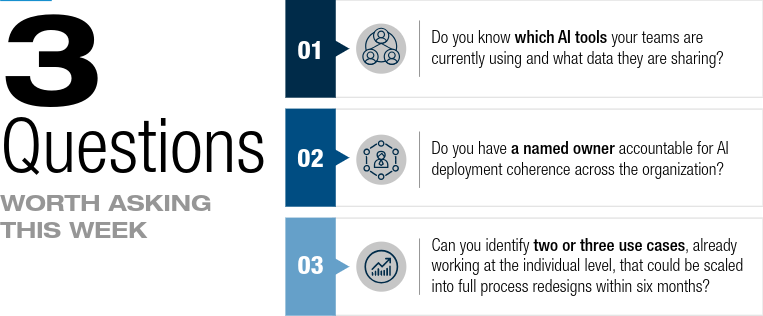
From what we are seeing in the market, the bottleneck is rarely technological. Organizations that struggle to scale AI almost always share the same root cause: nobody owns the translation from individual use to organizational value. The gap between "AI happening inside the organization" and "AI embedded in how the organization operates" is where value is either created or lost.
Making that transition requires resisting two symmetrical mistakes. The first is moving too slowly, waiting for a perfect governance framework before allowing any scaled deployment, thereby ceding ground to competitors while your own teams work around the restrictions. The second is moving carelessly, scaling individual tools without redesigning the underlying processes, producing AI-shaped optimizations of fundamentally unchanged operating models.
The goal is not to replace what your people have already built. It is to orchestrate it to turn isolated, unassumed use into deliberate, organization-wide deployment where individual gains compound into structural advantage.
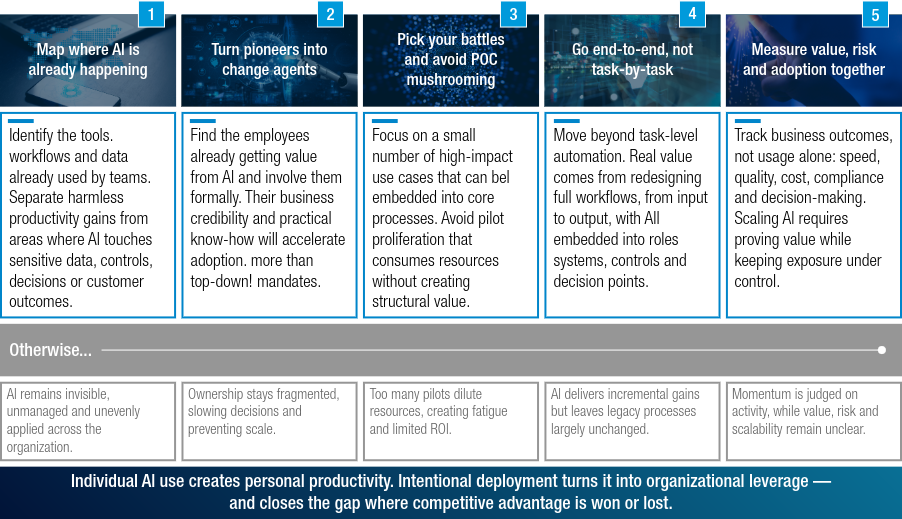
Five Success Factors for Scaling AI With Intent
|
The Pioneers in Your Organization Are Your Greatest Asset
Acquiring Claude or ChatGPT licenses for your employees is a necessary first step, but it is not a strategy. The real work is building the organizational use-case library that will turn individual access into collective value. And that library should not be built from a blank page.
Your pioneers are the right starting point. They are not necessarily the most senior or the most technical employees in the room. They are the curious ones, people who combine a deep understanding of their domain with an appetite for experimentation. They have already identified where AI creates value in their specific context, tested it against real business problems, and absorbed the lessons that only come from practice. In short, they have already done what most organizations are about to invest significant time and budget trying to figure out.
Identifying these individuals, involving them formally in the deployment process, and recognizing their contribution are not soft management gestures. They are strategic moves. Their business credibility and peer legitimacy will drive adoption far more effectively than any top-down directive. They are, in many respects, the most efficient path from isolated use to scaled impact.
|
References
- CybSafe, “Study: Almost 40% of Workers Share Sensitive Information with AI Tools Without Employers’ Knowledge,” press release, September 26, 2024, https://www.cybsafe.com/press-releases/study-almost-40-of-workers-share-sensitive-information-with-ai-tools-without-employers-knowledge
- IBM, “IBM Report: 13% of Organizations Reported Breaches of AI Models or Applications, 97% of Which Reported Lacking Proper AI Access Controls,” IBM Newsroom, July 30, 2025.