Offshore jurisdictions such as The Cayman Islands as well as Guernsey and Jersey in The Channel Islands have traditionally been used by both North and South American fund managers and investors as the jurisdictions to establish investment fund structures as well as feeder vehicles into investment funds based in, for example, the European Union (“EU”).
There has recently been a trend for these fund managers and investors to consider alternative jurisdictions following the introduction of the EU’s list of non-cooperative tax jurisdictions (“EU blacklist”) in December 2017 which was introduced to improve tax governance globally, and to ensure the EU’s international counterparts respected the same tax standards as EU Member States to prevent tax avoidance and harmful tax practices.
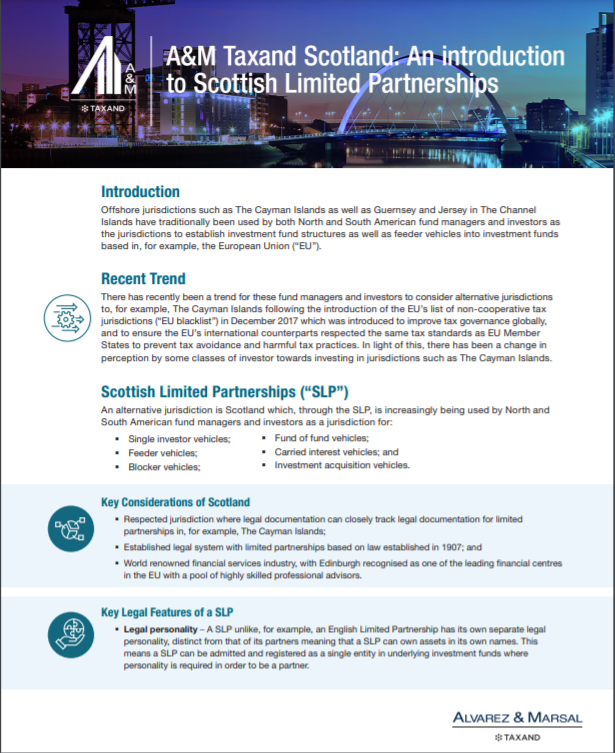
To help fund managers and investors consider alternative jurisdictions for investment fund structures as well as feeder vehicles into investment funds, the A&M Taxand team has prepared a new article an explaining the key benefits, considerations and legal features of Scottish Limited Partnerships (“SLP”).
 |
Click here to read our full guidance on SLPs.
|

Code of Practice 9 – What Is It and Is It Right for You?
December 12, 2025
At A&M, we regularly work alongside our clients’ existing advisors to ensure that they benefit from our extensive experience in managing Code of Practice 9 enquiries.
A&M Benefits Reference Guide
December 11, 2025
Many of the limits that pertain to qualified retirement plans and benefit plans are set by the Internal Revenue Service (IRS) and are subject to cost-of-living adjustments. In 2026, employees will be able to increase their retirement savings and contributions to health savings accounts as a result of the increased limits. The IRS limits for 2026 are summarized in the table below along with certain important compliance deadlines.
Pharma in Focus: A Prescription for Thai Tax & Tariff Health
December 8, 2025
Alvarez & Marsal recently hosted an engaging and practical session tailored for tax, finance, and trade professionals in the pharmaceutical industry. This first edition of our Thailand Tax Talk: Industry Series explored how tax leaders in the pharma sector can respond to increasing regulatory pressure, operational complexity, and cross-border trade disruption.
Supreme Court Upholds Delhi High Court Ruling: Indian Subsidiary Does Not Automatically Constitute PE, and No Further Profit Attribution Is Warranted Once the Subsidiary Arm’s Length Remuneration Is Paid
December 5, 2025
The Supreme Court’s affirmation of the Delhi High Court ruling in the Progress Rail case provides important clarity on Permanent Establishment standards in India.
The decision reinforces key principles on control, core functions, agency thresholds, and profit attribution.
It further underscores that arm’s-length remuneration to Indian subsidiaries precludes additional attribution.
A significant development for multinational enterprises evaluating their India-linked operating models.