A Look into the Evolving Role of AI in Vehicles
This edition of the Automotive Industry Spotlight will focus on changes to vehicle features as original equipment manufacturers (OEMs) continue to adopt Artificial Intelligence (AI).
In industry news:
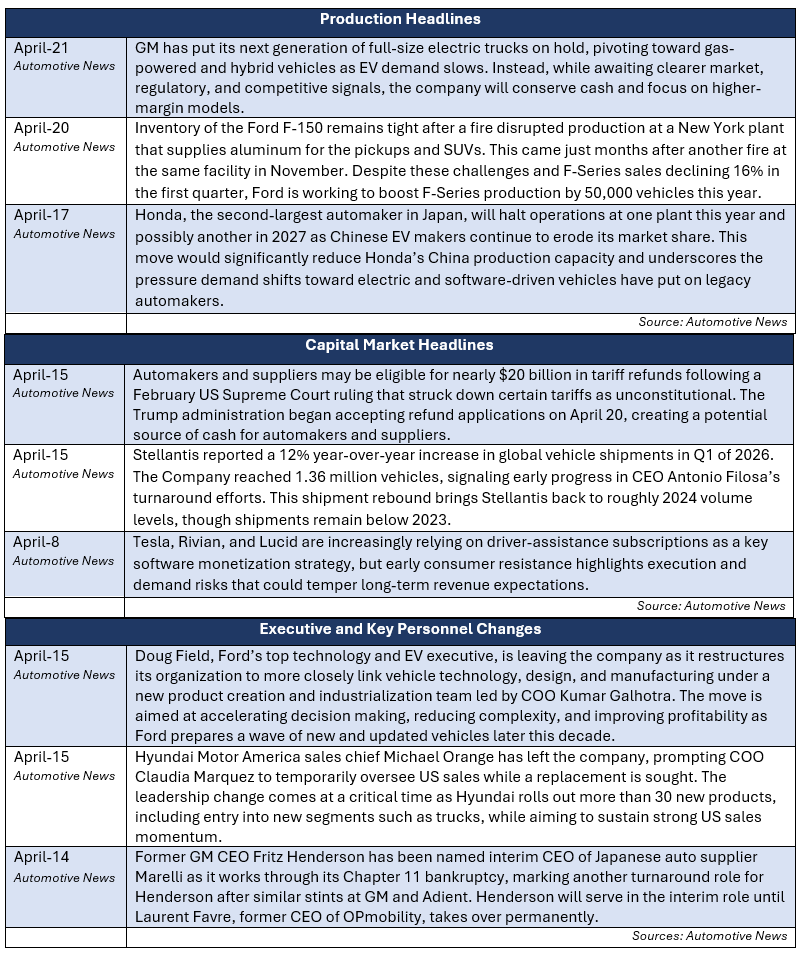
- Electric Vehicle (EV) demand slowdown drives strategic pivot – General Motors (GM) has paused production of its next-generation, full-size electric trucks, shifting focus back to gas-powered and hybrid vehicles amid slower EV demand and a push to preserve margins.
- Supreme Court ruling unlocks potential cash inflow – Automakers and suppliers may be eligible to receive nearly $20 billion in tariff refunds following a US Supreme Court decision, with applications opening April 20.
- Leadership transition amid organizational restructuring – Ford technology and EV chief Doug Field is leaving the company as it reorganizes to better align vehicle technology, design, and manufacturing.
In regulatory news:
- Fluctuating Fuel Costs – Though they are mainly driven by the price of crude oil, gasoline prices are also influenced by regional refining, distribution, taxes, and marketing costs.
- Automakers Are Reconsidering Sedans – After a decade of SUV dominance, automakers are reconsidering sedans as rising vehicle prices, strong Camry and Accord sales, and shifting emissions rules renew demand for more affordable passenger cars.
- Blockage of Chinese Vehicles in the US – Three US senators are urging President Trump to bar Chinese automakers from building vehicles in the US or entering via Mexico or Canada.
Industry Focus: AI and the Evolving Vehicle Experience
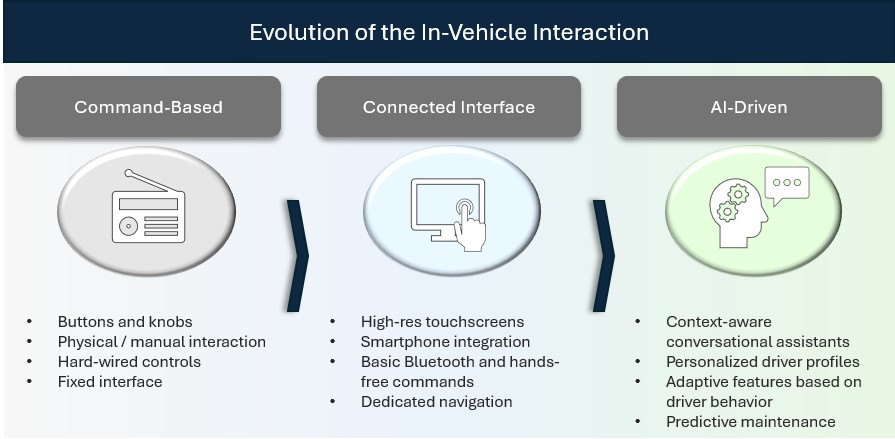
AI is beginning to take a more visible role in shaping the in-vehicle experience. As these capabilities develop, the current landscape can be viewed across three areas: the shift toward conversational interfaces, the emergence of more personalized vehicle environments, and the evolving question of how these features will be monetized.
Commands to Conversation
AI has taken a more visible role within the vehicle itself, particularly through the evolution of in-car interfaces. Historically, existing voice systems have operated on a command-based structure, requiring drivers to issue specific prompts to control navigation, climate, or media. More recently, the industry has begun rolling out conversational assistants powered by generative AI that enable more natural and open-ended interactions. For example, Volkswagen announced plans to introduce AI-powered voice agents in the China market, reflecting an initiative to keep up with the broader industry push toward more intuitive, dialogue-based systems.[1] While these developments suggest a shift in how drivers will interact with their vehicles, they also point toward an opportunity for these capabilities to expand across a wider range of features, both within the vehicle and beyond the traditional driving experience.
A More Personalized Driving Experience
In parallel, automakers are advancing personalization capabilities that allow vehicles to learn and adapt to individual driver preferences over time. These systems can adjust settings such as seat position, climate, and drive modes while also anticipating behaviors like preferred routes or driving patterns. Recent announcements from BMW highlight efforts to enhance its Intelligent Personal Assistant with AI-driven capabilities. Not only would this enable more context-aware interactions and personalized responses, but this technology would also advance digital driver profiles that can store and transfer individual preferences across vehicles.[2] Over time, the vehicle may begin to function less as a static product and more as a responsive environment. At the same time, the degree to which consumers value automated personalization relative to manual control remains an open consideration.
Monetization and the Ownership Model
As in-vehicle and AI-enabled capabilities expand, questions have emerged around how they will be positioned within the broader ownership model. Automakers have increasingly explored subscription-based offerings tied to connected and software-enabled features, including those supported by AI. For instance, GM has outlined plans to integrate more advanced AI functionality into its software platforms that could lead to new service-based revenue opportunities over time.[3] However, early indications suggest that while consumers express interest in advanced functionality, willingness to pay incremental fees is less consistent.[4] This dynamic introduces some uncertainty around whether AI-enabled features will primarily serve as differentiators within standard vehicle packages or evolve into meaningful, recurring revenue streams.
Balancing Capability with Adoption
Taken together, these developments point to a vehicle experience that is becoming more adaptive, interactive, and software driven. The underlying technology continues to advance, but the pace of adoption may ultimately depend on how these features are received by consumers and how seamlessly they integrate into everyday use. As AI becomes more embedded in the vehicle, the interplay between functionality, perceived value, and user acceptance may shape how quickly these capabilities move from emerging features to standard expectations.
Sources
[1]. Reuters: Volkswagen to equip Chinese cars with AI agents, in bid to catch up in tech
[2]. BMW: Generative In-Vehicle AI
[3]. GM News: GM announces eyes-off driving, conversational AI, and unified software platform
[4]. Yahoo! Finance: Car Buyers Don't Like Subscriptions. Car Companies Are Pushing Them For Driver-Assistance Tech Anyway
Additional insights are included below.
Industry Update
March inventory levels increased modestly to 2.89 million units, up from 2.85 million in February, reflecting a 1.3% month-over-month increase. Despite the slightly higher inventory levels, days’ supply declined meaningfully to 79 days from 96 in February, driven by a notable improvement in sales pace during the month. The stronger March performance follows weather-impacted results in January and February and contributed to a more balanced inventory position entering the spring selling season.
The underlying mix remains uneven across price points. Inventory of vehicles priced below $40,000 continues to show relative tightness, supported by steady demand and limited supply availability. In contrast, inventory growth remains concentrated in vehicles priced above $40,000, where supply continues to outpace demand. This dynamic has contributed to stable average listing prices while reliance on incentives to support volume has increased.[1]
Sources
[1]. Cox Automotive: Days’ Supply Falls in March, After Elevated Readings in January and February
Regulatory Landscape
Fluctuating Fuel Costs: Gasoline prices are driven mainly by crude oil costs—which typically make up about half of the price at the pump—while refining, distribution, taxes, and marketing account for the rest of the cost and vary by region. Recent price spikes were fueled by geopolitical disruptions in the Middle East, including a temporary blockage of the Strait of Hormuz that tightened global supply and pushed prices higher. However, regional price disparities have reflected differences in environmental regulations, refinery capacity, transportation infrastructure, and state fuel taxes, with California being among the most expensive markets. Seasonal fuel blend requirements can also lift prices, though regulators may ease those rules during supply shocks. Even after tensions ease, prices will likely remain elevated due to market uncertainty and the time lag between crude production and gasoline delivery.[1]
Why Automakers Are Reconsidering Sedans: Automakers are reconsidering sedans as rising vehicle prices and shifting regulations create renewed demand for lower-cost passenger cars. With average new-vehicle prices exceeding $50,000, remaining sedan models from Toyota, Honda, and Kia are seeing strong sales momentum because they appeal to cost-conscious buyers. Several automakers, including GM, Stellantis, Ford, Infiniti, and Mitsubishi, are exploring new sedan launches to fill affordability gaps and diversify product lineups. While SUVs and crossovers are expected to remain dominant, analysts see sedans reclaiming a modest share of sales as an underserved and more fuel-efficient alternative.[2]
Blockage of Chinese Vehicles in the US: Three Democratic senators urged President Trump to block Chinese automakers from building vehicles in the US or entering the market through Mexico or Canada, citing national security risks and unfair competitive advantages. Lawmakers argue Chinese vehicles pose data and supply-chain risks and could undermine US automakers despite potential short-term job creation. The call comes amid strong bipartisan and industry support for keeping Chinese automakers out of the US and is reinforced by Biden-era regulations that effectively bar Chinese passenger vehicles from the country. Trade groups and lawmakers are pressing for further action ahead of a planned summit between President Trump and President Xi, signaling continued policy risk around foreign auto investment and trade.[3]
Sources
[1]. Automotive News: Fluctuating fuel costs: How refiners, retailers and regulators set the price at the pump
[2]. Automotive News: Why automakers are reconsidering sedans after years of crossover dominance
[3]. Automotive News: 3 Democratic senators urge Trump to block Chinese cars from US
Stay connected to industry financial indicators and check back in May for the latest Auto Industry Spotlight.
Automotive Industry Spotlight Archive