MIDDLE EAST TAX ALERT | UAE | Fees and Charges Connected With a Life Insurance
Analysis of FTA Directive on Tax Transactions No. 4 of 2026 | Issued July 14, 2026
Key Takeaway The Directive confirms that fees and charges connected with a life insurance or life reinsurance contract may be treated as part of the VAT-exempt supply, but only when the services are necessary to and directly connected with the life insurance or life reinsurance supply, and when the consideration is embedded in the premium with no separate charge. |
Executive Summary
The FTA clarifies the VAT treatment of fees and charges forming part of life insurance and life reinsurance contracts. The exemption can extend beyond the core insurance premium to related fees and charges, but only when the Directive’s conditions are met.
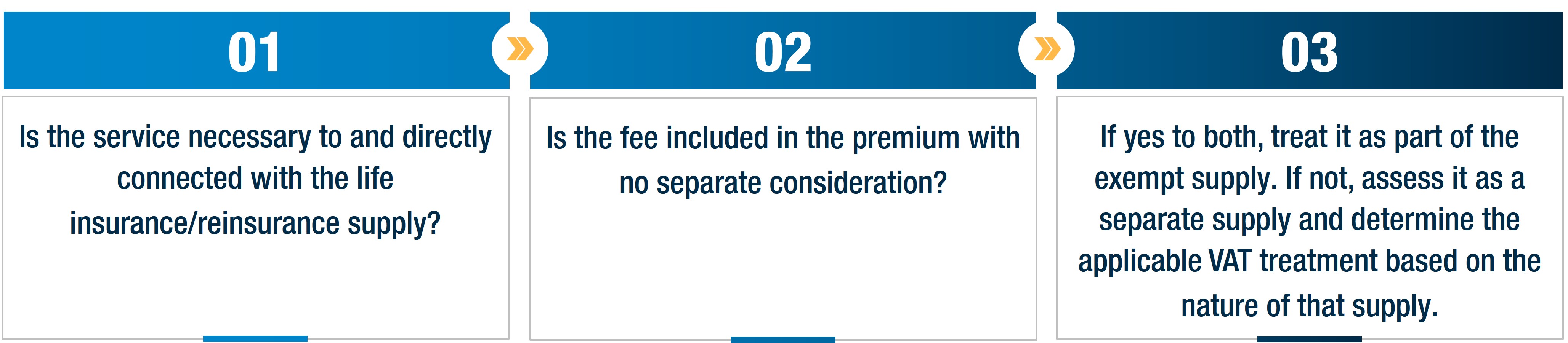
The key determinant is not the label of the charge. The analysis should focus on whether the service is necessary to the life insurance/reinsurance supply, directly connected with the provision, operation, or transfer of the life insurance/reinsurance contract, and whether the consideration forms an integral part of the total consideration payable under the contract.
When related fees are separately charged, or when the services are independent in nature and not essential to the provision of the life insurance/reinsurance contract, they should be assessed as separate supplies and may be subject to VAT depending on their nature.
Impact for Insurance Companies
| Point | Directive Position | Practical Implication |
| Connected Services | Services connected with a life insurance/reinsurance contract may form part of the exempt supply only when they are necessary to and directly connected with that supply, and no separate consideration is charged. | Insurers should map fees against the policy lifecycle and document why the service is integral to the exempt supply. |
| Premium Inclusion Test | The exemption applies only when the related fees and charges are included in the insurance premium and no separate consideration is charged. | Separate fee lines, add-ons, or explicit administrative charges require careful review and may create exposure to taxable supply. |
| Examples of Eligible Fees | Fees relating to the management, operation, or execution of a life insurance/reinsurance contract may qualify if the conditions are met. | Charges such as administrative charges, fund management charges, and benefit charges may may potentially relate to the management, operation, or execution of the policy. They may qualify for exemption when they are necessary to the life insurance/reinsurance supply, directly connected with the contract, and embedded in the premium with no separate consideration charged. |
| Independent Services | Services that are independent in nature, non-essential to the life insurance/reinsurance supply, or separately charged should generally be assessed as separate supplies for VAT purposes. | Charges such as funds/strategies switching, partial withdrawal charges, surrender charges, or bank/payment processing charges should be assessed separately when they are optional, separately charged to customers, or triggered by a separate policyholder action rather than being part of the core life cover. Surrender and withdrawal charges may still require closer analysis when they are embedded in the policy terms. |
VAT CLASSIFICATION APPROACH
A Practical Decision Framework
Risk Flags To Watch
| Post-Issuance Fees Separately Charged to Policyholders | Requires careful review of whether the charge is necessary to and directly connected with the life insurance/reinsurance supply. | Higher-Risk Indicator |
| Separate Policy Administration Fees | A separately charged fee may be viewed as an independent supply. | Higher-Risk Indicator |
| Charges Described Inconsistently Across Documents | Inconsistency may weaken the position that the fee is integral to the premium. | Moderate-Risk Indicator |
| Optional Add-On Services | Optionality can indicate that the service is not necessary for the insurance supply. | Moderate-Risk Indicator |
| Reinsurance Administration Recharge | Assess whether the charge is integral to life reinsurance or a separate service. | Moderate-Risk Indicator |
| Embedded Execution/Servicing Cost | Likely lower risk when the cost is genuinely built into the premium and no separate charge exists. | Lower-Risk Indicator |
A&M View
The FTA Directive clarifies that fees and charges connected with life insurance or life reinsurance may form part of the VAT-exempt supply, provided they are necessary to and directly connected with the life insurance/reinsurance supply, and embedded in the premium with no separate consideration charged.
Insurance Companies should document the VAT treatment of individual charges and any related bifurcation within policy documentation. This will help support the adopted VAT position, particularly where separate charges are treated differently from the underlying insurance supply and in light of the FTA's approach to single and composite supplies (mentioned in VATP040).
The fact that a charge is connected to a life insurance policy is not, by itself, sufficient. The charge must meet the Directive’s functional and charging-mechanism conditions before it can be treated as part of the exempt supply.
The VAT treatment should be assessed based on the nature of each charge, the contractual wording, and the actual charging mechanism, not merely the label used. Insurers should therefore review policy terms, premium mechanics, customer documentation, invoicing practices, and system tax codes to ensure that the VAT position for each charge is consistent and defensible.