A&M’s Digital Twin service operationalizes corporate compliance programs and measurably demonstrates compliance effectiveness in line with regulators' expectations. Our end-to-end regulatory and compliance intelligence service gives chief investigators, legal and compliance professionals the ability to drive better business transparency with increased agility, in turn, driving better business performance, cost savings and integrity.
Anti-bribery and anti-corruption Digital Twin addresses the legal and compliance risks in companies' financial data bringing better transparency into:
- Sanctions and trade compliance
- Fraud, waste and abuse
- Third-party risks and improper payments
- Revenue recognition and customer/distributor risks
- Conflicts of interests and segregation of duties
- Employee travel and entertainment
Learn More about A&M's Digital Twin here.
Contact Vincent Walden and Jeremy Tilsner to Learn More
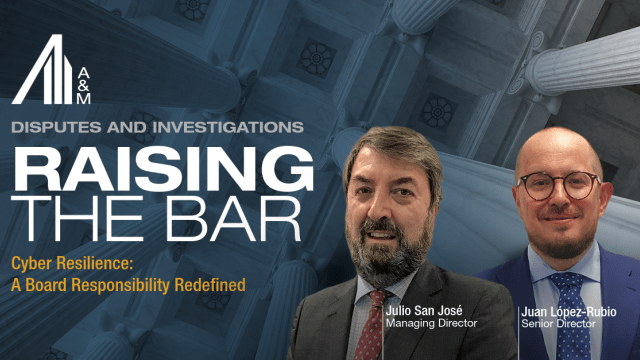
Cyber Resilience: A Board Responsibility Redefined
August 24, 2026
Cyber threats are moving faster, AI is changing how attacks are carried out, and advances in quantum computing could put today’s encrypted data at risk in the future. Managing Director Julio San Jose and Senior Director Juan Lopez-Rubio Fernandez explore what these shifts mean for business leaders and why cyber resilience is increasingly a board-level responsibility.
The New ICC 2026 Arbitration Rules
August 12, 2026
The ICC's new 2026 Arbitration Rules are the biggest update since 2021, bringing faster timelines and tighter disclosure rules. Here's what it means for experts working on ICC cases.
The Dual Mandate: AI for IA & IA for AI
August 7, 2026
Alvarez & Marsal hosted The Dual Mandate: AI for IA & IA for AI, bringing together senior Internal Audit leaders for an evening of practical discussion on how organizations are navigating AI adoption while strengthening governance and assurance.
The £3.3 Million Legal Victory Protecting the House That Hosted a Tudor King
August 3, 2026
Alvarez & Marsal senior director Mohammad Yadollahi’s expert testimony recently helped claimants win £3.3 million pounds in damages for a historic building where King Henry VIII once stayed.