This article was published on KYC360.com on March 12, 2018.
With digital currencies on the rise, cryptocurrency proponents are pushing for more open financial systems to, in part, serve the under-banked and reduce transaction costs. In this article, A&M’s Rachel Crabtree and Michael Carter stress that cryptocurrency firms who are proactive in establishing strong compliance controls are likely to avoid future pain of regulatory scrutiny.
By implementing effective and efficient compliance programs, crypto firms will help to stabilize and legitimize cryptocurrency’s purchasing power and may lead more banks to establish relationships with crypto exchanges. Further, the use of blockchain technology as the standard reporting platform between banks and exchanges and the application of blockchain to compliance functions will help alleviate common misperceptions of the use of crypto for nefarious purposes.
Click here to read the article >
The New ICC 2026 Arbitration Rules
August 12, 2026
The ICC's new 2026 Arbitration Rules are the biggest update since 2021, bringing faster timelines and tighter disclosure rules. Here's what it means for experts working on ICC cases.
The Dual Mandate: AI for IA & IA for AI
August 7, 2026
Alvarez & Marsal hosted The Dual Mandate: AI for IA & IA for AI, bringing together senior Internal Audit leaders for an evening of practical discussion on how organizations are navigating AI adoption while strengthening governance and assurance.
The £3.3 Million Legal Victory Protecting the House That Hosted a Tudor King
August 3, 2026
Alvarez & Marsal senior director Mohammad Yadollahi’s expert testimony recently helped claimants win £3.3 million pounds in damages for a historic building where King Henry VIII once stayed.
Third-Party Risk Management: You Can Outsource the Task — Not the Risk
August 3, 2026
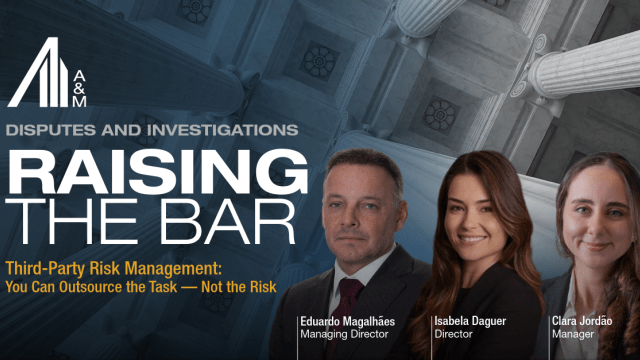
Third-party relationships create efficiency, but the risk stays with you. In this Raising the Bar piece, Eduardo Magalhaes, Isabela Dauger, and Clara Jordão break down why regulators are holding companies accountable for their vendors' failures.