Negative margins and Supply Chain challenges continue to plague healthcare organizations. Broad, non-labor assets (supplies, drugs, and purchased services) may not be fully understood or optimized. Our Non-Labor/Supply Chain professionals can advise and develop customized, operational improvement and tactical expense reduction solutions, including the use of levers such as price reduction, utilization reduction and waste reduction, among others.
At this pivotal time for healthcare Supply Chain, staff burnout/fatigue and under-sourcing has hampered the ability to realize the full potential of many hospital Supply Chain functions. Our experts can help organizations identify, deliver, educate, and coach respective stakeholders to achieve significant financial and operational improvements in all facets of medical supplies, drugs, and purchased services.
Rely on us for help with:
| Supply Chain |
|
Supply Chain Operations Improvement |
| |
|
|
- Identification and implementation of uncovered opportunities, including clinical integration
- Expedited spend diagnostics (price variances to market, etc.)
- Narrow (select categories/contracts) or broad focus (financial target), based on specific needs
|
|
- Identify variances to leading practice in key Supply Chain functions, with an eye toward unique needs in People (roles), Process and Technology.
- Implementation of customized strategies to yield improvements in cost, response time and customer satisfaction.
|
| |
|
|
| Ad-Hoc, Rapid Consultation |
|
Interim Management |
| |
|
|
- Evaluation of key strategies/documents, such as business plans and individual contracts / vendor proposals
- Speaker’s bureau for market education on common Supply Chain topics (e.g., SC Performance Dashboards)
|
|
- Short or longer-term assignments to keep operations moving and identify improvements
- Supply Chain VP, Sourcing and Contracting Managers, and other ancillary leaders (e.g., Value Analysis leader)
|
Webinar: AI in Action – Unlocking Enterprise Value Across the Health Plan Ecosystem
August 6, 2026
Watch our webinar to learn how health plans can unlock AI-driven value, scale successful initiatives and achieve measurable operational and financial impact.
Lee Health is Transforming Growth Into a Truly Integrated Health System
August 4, 2026
Healthcare transformation isn't just about growing. It's about creating a system where patients experience coordinated, seamless care.
Beyond the Bottom Line: Leading with Purpose at Phoenix Children's
July 28, 2026
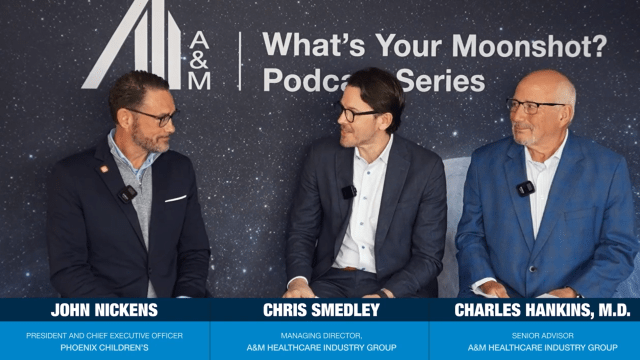
Healthcare leadership isn't just about today's outcomes—it's about shaping the future. John Nickens, President and CEO of Phoenix Children's, joins A&M Healthcare Industry Group's Christopher Smedley and Charles Hankins, M.D. to discuss leading beyond the bottom line, including investing in people, culture and strengthening the communities his organization serves.
From Sideline to Center Stage: The Rapid Rise of ICHRA for Health Plans. Are You Ready?
July 23, 2026
The Individual Coverage Health Reimbursement Arrangement (ICHRA) market has reached a tipping point. Enrollment nearly tripled in 2026—a 2.8x increase over 2025, with between 400,000 and 800,000 Americans now enrolled and the redistribution of group membership has begun. This is not incremental change.